
Virtual staging is transforming Australian property marketing by making listings more appealing online, faster, and at a fraction of the cost of physical staging. With over 90% of property searches starting online, buyers need to visualise how a space can be used – and empty rooms rarely achieve this. Virtual staging adds digital furniture and decor to photos, helping buyers connect with a property for as little as $30 AUD per image, compared to $1,500–$10,000+ for traditional staging.
Key takeaways:
- Cost: Virtual staging costs $30–$120 per image, while physical staging starts at $1,500.
- Speed: Virtual staging is delivered in 24–48 hours, compared to a week or more for physical setups.
- Impact: Staged homes sell up to 75% faster and often exceed their asking price.
- Challenges: Properties appear empty during inspections, but printed staged photos can bridge the gap.
From Sydney apartments to Melbourne suburban homes, virtual staging is helping properties stand out in competitive markets. It’s a fast, affordable way to attract buyers – especially interstate and overseas viewers – while boosting inspection rates and sale prices.
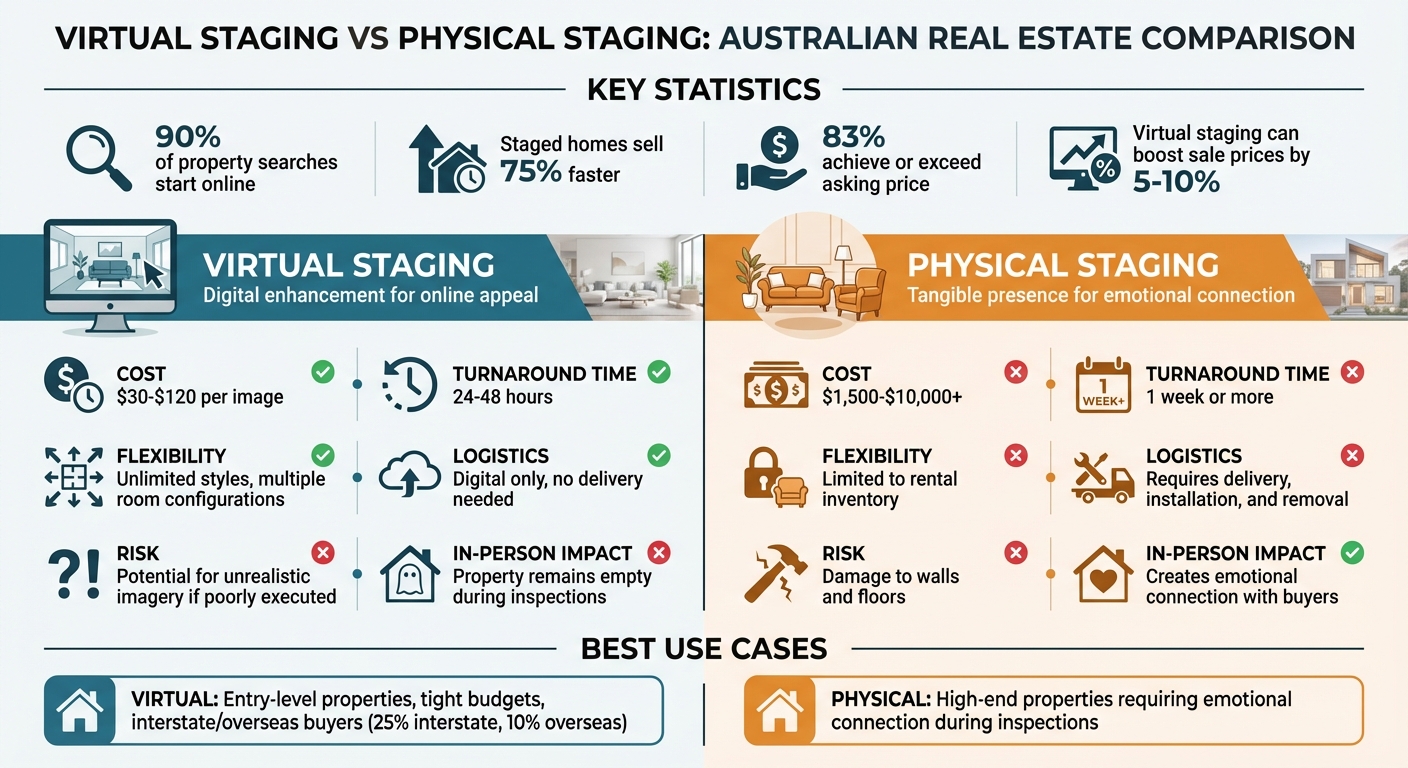
Virtual vs Physical Staging Costs and Benefits Comparison
1. Sydney Condo Transformation
Visual Appeal and Design Transformation
An empty Sydney condo can feel stark and uninviting, making it tough for potential buyers to imagine themselves living there. Virtual staging solves this by digitally adding realistic furniture, rugs, and artwork to high-quality photos of the space. This process transforms an empty property into a warm, welcoming home, helping buyers better understand the size and purpose of each room.
For high-end Sydney areas like Bondi Beach, human-led virtual staging stands out as the preferred option over AI-generated alternatives. Why? It ensures accurate details like geometry, lighting, and shadows, avoiding the awkward "floating furniture" effect that can break trust. Virtual staging also allows for creative, multi-functional designs – showcasing a room as both a nursery and a home office, for example – broadening its appeal to a wider range of buyers. These visually enhanced listings grab attention online, sparking curiosity and leading to more buyer interest.
Impact on Buyer Engagement
Virtual staging is especially useful for Sydney properties, where many potential buyers are interstate or overseas. Since these buyers often rely on online listings, agents face the challenge of maintaining the staged vision during in-person inspections. A common issue arises when buyers, who are impressed by virtually staged photos, visit the property only to find it empty. This can make it harder for them to connect with the space.
To address this, agents are adopting hybrid strategies. One effective approach involves placing easels with printed images of the virtually staged rooms in the property during inspections. This helps bridge the gap between the online experience and the physical visit, ensuring buyers stay engaged throughout their journey.
Cost Efficiency and Turnaround Time
Virtual staging isn’t just effective – it’s also budget-friendly and fast. Human-led virtual staging typically costs between $30 and $120 per image, with complete packages available for a few hundred dollars. Compare this to traditional staging in Sydney, which can range from $1,500 to over $10,000.
The speed of delivery is another major advantage. Virtual staging images are often ready within 48 hours or less, whereas physical staging can take at least a week to organise. For more affordable Sydney apartments, where staging budgets are limited, this combination of affordability and quick turnaround makes virtual staging the go-to option.
"It is, quite simply, the most cost-effective way to present a property to the market." – Suzi Buckley, Buyer’s Agent, Cohen Handler
sbb-itb-f3f2f9e
2. Melbourne Suburban Home Makeover
Visual Appeal and Design Transformation
Melbourne’s suburban homes often feature warm, family-friendly designs, a stark contrast to Sydney’s urban chic. These homes, however, are frequently empty during sale campaigns, making it difficult for potential buyers to visualise their potential. Virtual staging steps in to bridge this gap by digitally furnishing spaces with pieces that are perfectly scaled to the room dimensions. Styles like Hamptons, Scandinavian, Mid-Century Modern, and Contemporary are thoughtfully chosen to align with the character of the suburb and attract the right buyers.
This process isn’t just about adding a couch or a dining table. Virtual staging professionals pay attention to the finer details – like sheer curtains, polished floors, sleek cabinetry handles, and stylish pendant lighting – to create a welcoming, "move-in-ready" atmosphere. These carefully curated touches breathe life into the space, making it easier for buyers to connect emotionally and act decisively.
"Buyers are drawn to homes that feel light, spacious and ready to live in, that emotional response is what pushes them to bid higher." – Cayley Scrooby, Expert Stylist, Sovereign Interiors
Impact on Buyer Engagement
The results speak for themselves. Staged homes in Melbourne sell 75% faster than their unstaged counterparts, and 83% of these properties hit or exceed their asking price. Virtual staging also significantly boosts the visibility of online listings, increasing views by as much as 60%. Given that 90% of buyers begin their property search online, this enhanced visibility is a major advantage.
The financial benefits are equally striking. Professionally staged homes have been known to influence sale prices by up to $500,000, thanks to their ability to capture the interest of broader buyer demographics. For instance, three-bedroom homes in Fitzroy achieved an average price increase of $256,642 (14.00%), while larger properties in Brighton saw premiums of around $445,200 (11.70%).
Cost Efficiency and Turnaround Time
Virtual staging doesn’t just look good; it’s a cost-effective solution too. With prices ranging from $30–$120 per image and a delivery time of 48–72 hours, it’s a fraction of the cost and time required for traditional staging. In contrast, physical staging can cost anywhere from $1,500 to over $10,000 and typically takes at least a week to organise. For a suburban home needing eight to ten staged images, virtual staging costs average around $500 – far more budget-friendly than its physical counterpart.
This approach also eliminates the need for movers, delivery fees, or concerns about potential damage during setup. It’s particularly advantageous for multi-storey homes, where logistics can be more challenging.
"Physical staging can cost an owner several thousand dollars. Virtual staging can be delivered for a few hundred." – Jacob Caine, President, Real Estate Institute of Australia
3. Brisbane Townhouse Enhancement
Visual Appeal and Design Transformation
Staging Brisbane townhouses can be tricky, especially when dealing with empty spaces or homes filled with personal items. Virtual staging offers a smart solution by digitally adding stylish furniture and decor that resonate with Brisbane buyers. Professional designers carefully select themes like Hamptons, Modern Contemporary, and Farmhouse to evoke a sense of connection and warmth for potential buyers. Through digital decluttering, these spaces are transformed into clean, inviting interiors where buyers can easily picture themselves living. Unlike automated tools, professional designers ensure every detail – right down to the lighting and shadows – feels natural and realistic, bringing out the best in the property.
Impact on Buyer Engagement and Time-on-Market
The results of virtual staging speak for themselves. A townhouse at 3/66 Wagner Road in Nundah, Brisbane, marketed by Jordan Cleland of Clark Realty, sold in just 7 days – a staggering 90% faster than the area’s average of 71 days. The virtually staged images allowed buyers to clearly see the potential of the space, sparking quick interest and offers.
This isn’t an isolated case. Properties using virtual staging typically spend 61% less time on the market, and professional photos can boost buyer interest by as much as 118%. In Brisbane’s competitive real estate scene, high-quality staged images are a must for grabbing attention online and turning clicks into quick, competitive sales.
Cost Efficiency and Turnaround Time
Virtual staging delivers outstanding results without breaking the bank. Starting at just $30 AUD per image with a turnaround time of 12–24 hours – like the service offered by Fast Virtual Staging – it’s a fraction of the cost of traditional staging, which can range from $1,500 to $10,000. For a typical Brisbane townhouse requiring five to seven images, the total cost is around $150–$210 AUD, with the potential to boost sale prices by 5–10%.
Physical staging, on the other hand, often takes at least a week to arrange furniture and set up the space. Virtual staging eliminates these delays, enabling properties to hit the market within 24 hours. This speed not only helps sellers act quickly but also avoids the logistical hassles of traditional staging. It’s a fast, budget-friendly option that’s making waves in Australian real estate markets.
4. Perth Apartment Conversion
Visual Appeal and Design Transformation
Empty Perth apartments, especially in high-rise buildings, often feel cold and uninviting. Without furnishings, rooms can seem smaller and lack personality. Virtual staging changes this by adding lifelike digital furniture, helping buyers imagine the space’s potential. Using precise digital scaling, designers ensure that every piece fits perfectly within the room’s dimensions, avoiding the "empty box" effect.
What makes virtual staging even more appealing is its adaptability. Perth services offer a variety of styles – Hamptons, Scandinavian, Industrial, and Mid-Century Modern – allowing agents to match the apartment’s design to its architecture and target audience. This tailored approach makes properties stand out in Perth’s competitive market.
Impact on Buyer Engagement and Time-on-Market
The benefits of virtual staging extend beyond just appearances. In Perth, staged properties tend to sell or rent 75% faster than unstaged ones, with 83% achieving or exceeding the asking price. Considering that 90% of property searches begin online, high-quality visuals are crucial for grabbing attention.
Virtual staging also connects with a broader audience. About 25% of online viewers for Perth listings are interstate buyers, and 10% are from overseas. To bridge the gap between online and in-person experiences, some agents in Perth even display printed versions of virtually staged images during open houses.
Cost Efficiency and Turnaround Time
Virtual staging isn’t just about style – it’s also a cost-effective and efficient solution. In Perth, professional services start at approximately $54 per image, with a typical turnaround time of 48 to 72 hours. For high-rise apartments, it eliminates the hassle of moving physical furniture, booking lifts, or risking damage to walls and floors.
"Physical staging can cost an owner several thousand dollars. Virtual staging can be delivered for a few hundred." – Jacob Caine, President, Real Estate Institute of Australia
With the potential to boost sale prices by 5–10%, virtual staging is a smart investment. Perth’s success with this technique mirrors similar trends in cities like Sydney, Melbourne, and Brisbane.
Before & After Pics- Make More Money by Staging Your Home
Pros and Cons
Virtual staging has made a noticeable impact on Australian property marketing, but it’s not a one-size-fits-all solution. Deciding between virtual and physical staging depends on the specific needs of each property listing.
One of virtual staging’s biggest advantages is cost. With prices ranging from $30 to $120 per image, it’s a fraction of the expense of physical staging, which can cost anywhere from $1,500 to over $10,000. For budget-conscious sellers, especially in the entry-level market, this price gap can make a huge difference.
Speed and flexibility are other strong points. Virtual staging typically delivers results within 24 to 48 hours when handled by professionals, while physical staging can take over a week. What’s more, virtual staging allows for multiple design options – turning a single room into a nursery, a home office, or even a guest bedroom to suit different buyer preferences.
However, the biggest drawback lies in the inspection experience. Buyers who visit the property might feel a disconnect when the real space doesn’t match the staged images. As Stephen Mutton, National Head of Network Development at LJ Hooker, explains:
"The only potential downside of virtual staging is that the styling is not there upon inspection. But at least the seed has been planted".
While physical staging helps buyers form an emotional connection during walkthroughs, virtual staging can sometimes fall short if the images are poorly executed, resulting in unrealistic visuals like "floating" furniture.
Here’s a comparison of key features for both methods:
| Feature | Virtual Staging | Physical Staging |
|---|---|---|
| Cost | $30–$120 per image | $1,500–$10,000+ |
| Turnaround Time | 24–48 hours (human-edited) | 1 week or more |
| Flexibility | Unlimited styles; multiple room configurations | Limited to rental inventory |
| In-Person Impact | Property remains empty during inspections | Creates an emotional connection with buyers |
| Logistics | Digital only; no furniture delivery needed | Requires delivery, installation, and removal |
| Risk | Potential for unrealistic imagery if poorly executed | Risk of damage to walls and floors |
While virtual staging excels at boosting a property’s online presence, especially for modern Australian listings, its limitations mean it’s not always the right choice. Balancing these pros and cons is key to making the best decision for your property.
Conclusion
Before-and-after examples clearly show how virtual staging transforms vacant Australian properties into market-ready listings. These digital enhancements allow buyers to visualise a property’s potential and create an emotional connection – both critical factors in standing out in today’s competitive property market.
The numbers speak for themselves. Virtual staging costs between $30 and $120 per image and delivers results in just 24 to 48 hours, compared to the week or more required for traditional staging. This affordable and efficient approach is perfect for agents handling entry-level properties or working with tight marketing budgets.
Fast Virtual Staging has set a high standard in this space, offering photo-realistic renders for only $30 per image with a guaranteed 24-hour turnaround for residential orders. Their service also includes customisable design styles tailored to specific markets – be it a sleek Scandinavian aesthetic for a Sydney apartment or family-friendly layouts for a Melbourne suburban home. Plus, they offer two complimentary revisions and a dedicated account manager to ensure a seamless experience.
To get the most out of virtual staging, consider these practical tips:
- Always disclose virtual staging to maintain buyer trust and comply with Australian advertising laws.
- Showcase multiple room layouts to attract a broader range of potential buyers.
- Provide printed staged photos during inspections to help buyers visualise the possibilities they saw online.
While virtual staging can’t hide issues like outdated fixtures or worn flooring, it becomes a powerful tool when paired with proper physical preparation. Together, these efforts can make your listing stand out in a crowded digital marketplace.
FAQs
Will buyers feel misled if the home looks furnished online but is empty at inspections?
Buyers may feel deceived if a property that looks furnished in online listings turns out to be empty during inspections. Relying too much on virtual staging can lead to a gap between what buyers expect and what they experience, potentially affecting their trust and willingness to engage. To prevent this, clearly indicate that the images are virtually staged and ensure they accurately reflect the property’s actual layout and dimensions.
How many photos should I virtually stage for the best results?
For the best outcome, it’s suggested to virtually stage 3 to 6 photos per property. This approach focuses on showcasing key areas, helping the property stand out and capture the interest of potential buyers.
What should I do before virtual staging so the photos look realistic?
To create virtual staging that feels realistic, begin with high-quality, well-lit photos that clearly display the space. Pay attention to proper angles, ensuring the images capture the room’s layout effectively. Additionally, make sure the room is clean and free of clutter – this helps the digitally added furniture blend seamlessly while emphasising the room’s best features.