
When selling property in Australia, staging can make a big difference. Staged homes sell 73% faster and for 5–10% higher prices. But should you choose digital or physical staging? Here’s a quick breakdown:
- Digital staging: Uses computer-generated images to furnish photos of properties. It’s cheaper ($30–$135 AUD per image), faster (12–24 hours), and ideal for online listings. However, it lacks the in-person impact of physical staging.
- Physical staging: Furnishes the actual property for inspections. It’s more expensive ($2,500–$7,000+ AUD for 6 weeks) and takes more time (4–6 weeks), but creates a stronger emotional connection during viewings.
Quick Comparison
| Factor | Digital Staging | Physical Staging |
|---|---|---|
| Cost | $30–$135 AUD per image | $2,500–$7,000+ AUD (6 weeks) |
| Timeline | 12–24 hours | 4–6 weeks |
| Experience | Online visualisation only | In-person interaction |
| Flexibility | Unlimited design options | Limited by available furniture |
| Environmental Impact | Minimal | Higher due to transport and materials |
When to choose digital staging: Best for vacant properties, tight budgets, or fast-moving markets.
When to choose physical staging: Ideal for luxury homes, family properties, or creating emotional buyer connections.
A combined approach can work too: use digital staging for online listings and physical staging for key rooms during inspections.
Digital Staging: How It Works and What to Expect
The Digital Staging Process
Digital staging transforms property photos into fully furnished spaces using computer-generated imagery. The process typically unfolds in four steps: high-quality photography, digital enhancement, refinement, and a final review. It all starts with capturing professional-grade photos, which form the foundation for the virtual transformation. Designers then use advanced AI-powered software to furnish the space virtually, carefully selecting and placing furniture to complement the property’s style. These images are further refined to ensure the digital elements look natural and proportionate, followed by a thorough quality check.
Fast Virtual Staging simplifies this process for Australian real estate professionals, offering a quick 12–24 hour turnaround with customisable design styles like Scandinavian or Modern. At $30 AUD per image, the service includes two free revisions and a dedicated account manager to ensure the staging aligns with your marketing goals.
The rise of AI automation and augmented reality has propelled the digital staging market, currently valued at around $70 million, with an expected annual growth rate of 15%. This efficient process highlights the clear benefits of cost, speed, and flexibility, which are explored below.
Advantages of Digital Staging
One of the biggest advantages of digital staging is its affordability – costing up to 97% less than traditional physical staging. Prices generally range from $42 to $200 AUD per image, making Fast Virtual Staging’s $30 AUD rate an appealing option.
Speed is another standout benefit. While physical staging can take weeks, digital staging is often completed in just hours or a few days. This rapid turnaround is especially valuable in Australia’s fast-moving property market, where listings with high-quality photos can receive up to 60% more views.
Flexibility is also a major draw. Digital staging allows real estate professionals to explore different furniture styles, colour palettes, and layouts without the limitations of physical staging. This adaptability makes it easier to tailor presentations to a variety of buyer tastes and emerging design trends.
On top of that, digital staging offers environmental advantages. By eliminating the need for transporting, storing, and disposing of physical furniture, it significantly reduces the carbon footprint associated with property marketing.
Digitally staged listings also tend to attract more interest. These enhanced images often generate more clicks and inquiries, and properties with well-presented photos can sell for 5–10% higher prices. Additionally, 41% of buyers are more likely to schedule an in-person viewing after seeing staged images online. This makes digital staging a powerful tool for bridging the gap between online engagement and physical property visits.
Digital Staging Drawbacks
Despite its advantages, digital staging isn’t without its challenges. One major limitation is that it can’t replicate the tactile experience of a physically staged home.
Another issue is the potential for unrealistic expectations. Kristie Barnett, Founder of The Decorologist, points out:
"It may initially raise buyers’ expectations and set them up for a let-down when they see rooms in person."
This gap between the polished digital presentation and the actual property can lead to disappointment during inspections, affecting buyer sentiment and possibly influencing negotiations.
Perception issues are another concern. Some buyers may view virtual staging as unprofessional or even deceptive. Additionally, technical limitations can sometimes result in overlooked features or missed opportunities to highlight a property’s unique selling points.
Transparency is crucial in addressing these concerns. Real estate professionals must clearly disclose that photos have been virtually staged to maintain trust and comply with legal standards . Many agents address this by showing original photos alongside the digitally enhanced ones.
| Best Practices | Practices to Avoid |
|---|---|
| Clearly label digitally staged photos | Using edits to hide property damage |
| Show original photos alongside staged versions | Changing fundamental features, like room size |
| Use realistic and achievable virtual enhancements | Adding non-existent elements, like pools or fireplaces |
| Adhere to industry regulations and legal requirements | Skipping disclosures about digital staging |
Physical Staging: How It Works and What to Expect
The Physical Staging Process
While digital staging offers convenience, physical staging provides a hands-on experience that resonates deeply with potential buyers. This process transforms a property through a structured seven-step approach: consultation, quoting, contracting, maintenance or renovations, design, staging, and de-staging.
It all starts with the consultation. Stylists visit the property to assess its needs, recommending repairs or updates, which can cost anywhere from $150 to $500 AUD. After this, the space is decluttered, and any existing furniture is removed to create a blank canvas for staging.
From there, the design phase begins. Furniture and décor are carefully chosen to match the home’s style and appeal to the target market. The focus is on maximising natural light and ensuring every corner is spotless. Even outdoor spaces get a makeover, with inviting furniture and greenery added to enhance the overall appeal. Once staged, the setup typically remains for 4–6 weeks, with extensions available at an extra weekly cost. Finally, when the property is sold, the de-staging process involves removing all the furniture and accessories.
This methodical process creates an environment where buyers can envision themselves living, fostering a strong emotional connection.
Advantages of Physical Staging
Physical staging has a unique ability to connect with buyers on an emotional level, something digital alternatives often struggle to achieve. Justine Wilson, Home Stylist and Founder of Vault Interiors, captures this sentiment perfectly:
"It’s like going on a first date. You don’t go out in your pyjamas, you do your hair and put on your makeup because presentation matters. So, it’s the same when you’re putting your home on the market, if you want the best price you’ve got to put your best foot forward."
Walking through a beautifully staged home allows buyers to experience the space in a way that feels personal and aspirational. Nicole Gleeson, Sales Agent and Partner at Kay & Burton in Melbourne, elaborates:
"I build emotional connections for buyers to fall in love with. When they’re looking at home online or in person you want them to feel ‘How could anybody live as beautifully as this? I want to live like this.’ That’s what I’m trying to achieve."
The financial benefits are equally compelling. Staged homes sell 73% faster than their non-staged counterparts, often fetching 17% higher prices. In Brisbane, for instance, staged properties can command 5–10% more than unstaged homes. One study even found that 49% of staged homes sold within the first week, and 66% sold within two weeks, with an average price boost of $69,017.
Consider this: a 4-bedroom house in Sydney priced at $3,000,000 could potentially sell for an additional 10% ($300,000) after staging, which might only cost $8,000.
Physical staging also helps properties stand out in competitive markets. Bianca Denham, National Director of Special Programs at Ray White, explains:
"A well-constructed styling package can make an old home look new, make small spaces appear bigger and are essential whenever there is an open-plan living area."
Physical Staging Drawbacks
Despite its advantages, physical staging does come with challenges. The cost is a significant factor. Over a six-week period, staging costs can range from $2,500 AUD for a studio to over $7,000 AUD for larger homes:
| Property Type | Staging Cost (6 weeks) |
|---|---|
| Studio/one-bedroom apartment | $2,500 AUD |
| Two-bedroom apartment | $3,600 AUD |
| Three-bedroom house | $5,000 AUD |
| Four-bedroom family home | $6,000 AUD |
| Larger homes (5+ bedrooms) | $7,000+ AUD |
Time is another hurdle. Unlike digital staging, which can be completed quickly, physical staging requires weeks of preparation. Coordinating furniture delivery, managing renovations, and dealing with unexpected delays – like bad weather – can extend the timeline.
Location also plays a role in both cost and availability. In cities like Sydney, Melbourne, and Brisbane, higher demand and operational expenses drive up staging fees. For regional properties, access to quality staging services may be limited, or additional delivery fees might apply.
Lastly, the environmental impact of transporting furniture and using packaging materials can be a concern for sellers who prioritise sustainability.
Digital vs Physical Staging: Side-by-Side Comparison
Cost, Speed, and Impact Comparison
When it comes to numbers, digital staging often takes the lead for sellers aiming to save on costs. It’s 80–95% cheaper than physical staging, making it an appealing choice for those working within a tighter budget.
| Factor | Digital Staging | Physical Staging |
|---|---|---|
| Cost Range | $30–$135 AUD per image | $2,500–$7,000+ AUD (6 weeks) |
| Timeline | 12–24 hours delivery | 4–6 weeks minimum |
| Flexibility | Endless design options | Limited by available furniture |
| Environmental Impact | Minimal carbon footprint | Transport and packaging required |
| Buyer Experience | Online visualisation only | Physical interaction during inspections |
Paul Duffy from Century 21 Advance Realty highlights the trade-off between the two methods:
"Real staging is quite expensive, but it’s obviously the best option because when people do come to look at the property they can actually see the furniture in the home and sit on it, feel it, see the sizes and how it works in the space. But this is the next best thing – to stage virtually, you can do it for $300 to $500."
Traditional staging can take weeks, while virtual staging delivers results in as little as 24 hours. For sellers racing against the clock in competitive markets, this speed can make all the difference.
Both methods have proven effective in boosting sale prices and reducing time on the market. Statistics show that 85% of staged homes sell for 5 to 23% over their listing price. Additionally, homeowners who invest in professional staging often see a return of 5–15% on their investment.
The choice between digital and physical staging ultimately depends on the property and market conditions.
When to Use Each Method
Deciding between digital and physical staging often comes down to the property’s specific needs and the expectations of potential buyers. According to research, over 41% of top real estate agents agree that vacant homes benefit the most from staging. Digital staging shines in these scenarios, helping buyers visualise how an empty space could feel like home.
Digital staging is ideal for:
- Vacant properties that might otherwise feel cold or uninviting
- Online listings where first impressions are crucial
- Sellers with limited budgets or tight deadlines
- Investment properties where maximising return is a priority
- Regional locations where physical staging options are scarce
Physical staging works best for:
- Luxury properties where buyers expect a premium experience
- Family homes aiming to create a warm, emotional connection
- Properties with unconventional layouts that need a tangible demonstration of space
- Markets where in-person inspections are critical to buyer decisions
- Homes likely to stay on the market for extended periods
Cost is another key factor. Virtual staging typically runs at about 1% of the sale price, while traditional staging can cost closer to 10%. For example, staging a $1 million property digitally costs around $10,000 AUD, while physical staging could reach $100,000 AUD.
Using Both Methods Together
A combined approach can offer the best of both worlds. Digital staging is perfect for creating eye-catching online listings, while physical staging can enhance the in-person experience during showings.
Start with digital staging to attract buyers online – 40% of buyers schedule a viewing after seeing a staged home online. Once interest builds, consider physical staging for key areas like the main living room and master bedroom. This strategy balances cost while delivering maximum impact.
This hybrid method takes advantage of digital staging’s speed and affordability while leveraging the tactile appeal of physical staging. It’s a strategy that’s gaining traction, with 96% of realtors agreeing that staging positively influences buyer decisions. By combining the two, sellers can ensure their property leaves a strong impression, both online and in person.
Timing is everything. Use digital staging from the start to grab attention, then add physical staging for priority rooms once serious buyers emerge. This lets you test the market’s response before committing to the higher costs of traditional staging, ensuring your property is ready to impress at every stage of the process.
sbb-itb-f3f2f9e
How to Choose the Right Staging Method
What to Consider Before Choosing
When deciding on a staging method, it’s essential to weigh several factors that can influence your property’s market performance. One key consideration is property value – staging has been shown to boost sale prices by 7.5% to 12.5%.
Understanding your target buyer is equally important. For example, urban buyers often prefer sleek, minimalist designs, while suburban families are drawn to cosy, family-oriented decor. Your staging style should align with these preferences, as well as your marketing goals and budget. Statistics back up the value of staging: homes that are staged sell 73% faster and for 17% more on average. In Brisbane, staged homes can command a 5–10% higher sale price compared to non-staged properties. However, the costs can vary – physical staging for a medium-sized home (3–4 bedrooms) typically ranges from A$3,500 to A$7,500, with overall prices between A$1,500 and A$12,000. Digital staging offers a more budget-friendly alternative.
Time constraints are another critical factor. Digital staging can be completed in just 12–24 hours, whereas physical staging often requires weeks of preparation. In a slower market, where competition is fierce, staging becomes even more crucial to make your property stand out.
As Nicole Gleeson, a sales agent and partner at Kay & Burton in Melbourne, remarks:
"For me it’s not initially about creating a percentage difference in the sale price. It’s about creating competition"
Now, let’s explore why Fast Virtual Staging is an excellent fit for Australian real estate professionals.
Why Fast Virtual Staging Works for Australian Professionals
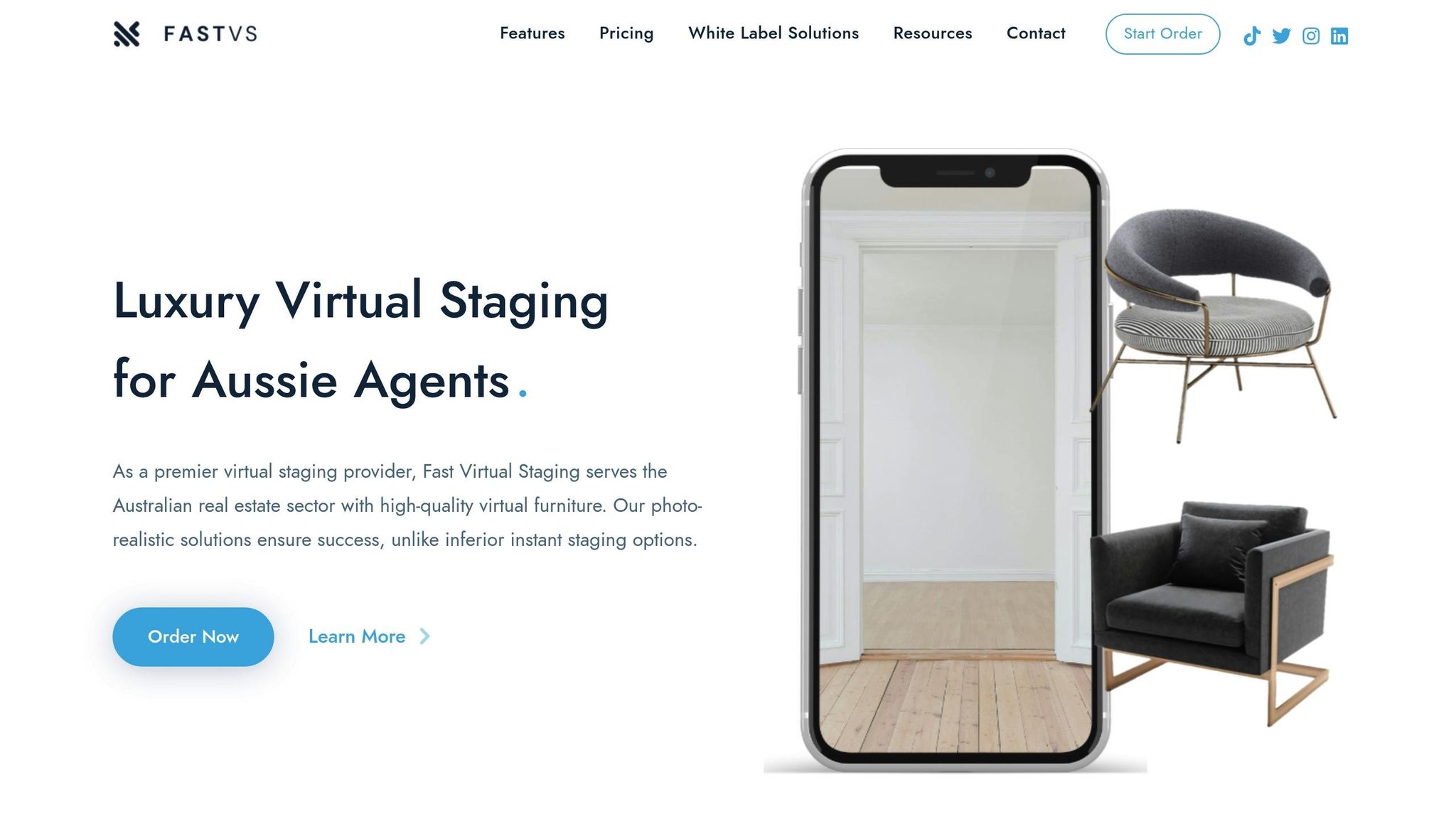
Fast Virtual Staging offers a practical solution tailored to the needs of Australian real estate agents. At just A$30 per image, it’s an affordable option that delivers photo-realistic results comparable to traditional staging methods.
Its quick turnaround time of 12–24 hours is especially valuable in Australia’s dynamic property markets. Whether you need to list a property quickly or adapt to shifting market conditions, this speed can be a game-changer. Plus, with two free revisions included, you can ensure the final images meet your expectations.
The platform’s customisable design options allow agents to target specific buyer demographics. Whether it’s a Scandinavian-inspired apartment in Melbourne or a contemporary family home in Brisbane, these flexible designs help create an emotional connection that encourages buyers to act.
For real estate photographers, white-label solutions simplify the process by integrating with their existing workflows. An assigned account manager handles multiple listings, and properties can be staged digitally regardless of location – a major advantage for regional areas.
Australian Buyer Preferences and Local Trends
Understanding Australian buyer preferences can further refine your staging strategy. Outdoor living spaces, for instance, are highly appealing – especially in Brisbane and other subtropical areas. Digital staging can transform empty patios and balconies into inviting spaces that highlight the relaxed Australian lifestyle.
The growing trend towards minimalist, modern interiors with neutral colour schemes aligns perfectly with digital staging capabilities. Buyers today expect a polished presentation, as Mathew Tiller from LJ Hooker Group notes:
"Ultimately, buyers seek homes that maximise value and this requires more than just uploading photos or videos online and hoping for the best"
Open-plan living areas, a hallmark of Australian homes, benefit greatly from staging that demonstrates flow and functionality. With more buyers seeking dedicated workspaces, digital staging can easily include home office setups to cater to this demand. Additionally, eco-conscious staging, which uses sustainable materials, is gaining popularity. Digital staging naturally supports greener practices by eliminating the need for physical furniture transport.
Younger buyers, particularly those interested in apartments and digital-first property experiences, are another key demographic. High-quality staged photos can attract up to 60% more online views, making digital staging an effective tool for this audience.
Regional preferences also matter. In areas where buyers value Australian-made materials and local design influences, incorporating these elements into digital staging can create a strong connection with prospective buyers.
What is Virtual Staging & is it Worth it?
Final Thoughts
Deciding between digital and physical staging comes down to your unique situation, budget, and target audience. Both approaches can deliver great results in Australia’s competitive property market.
For real estate professionals seeking a fast and budget-friendly option, digital staging stands out. At just A$30 per image and a turnaround time of 12–24 hours, it’s a cost-effective way to create photorealistic property images, cutting expenses by 80–90%. With the Australian virtual staging market expected to grow from USD 1.5 billion in 2024 to USD 4.7 billion by 2033, it’s clear this approach is gaining traction. Plus, with 96% of buyers starting their property search online, digital staging directly meets today’s market demands.
That said, physical staging offers something digital methods can’t: a hands-on, emotional connection during in-person viewings. As Kristie Barnett, founder of The Decorologist, explains:
"Traditional staging provides a tangible and immersive experience that helps buyers envision how their furnishings will fit into the space".
This approach works particularly well for luxury properties or buyers who value seeing spaces in person.
Combining both methods can be a smart move. Use digital staging to make your online listings stand out and attract interest, then apply physical staging to key properties for a more immersive experience. When deciding, think about factors like the property’s condition (vacant homes benefit greatly from digital staging), the preferences of your target buyers (millennials often lean toward digital, while baby boomers may prefer in-person experiences), your timeline, and your overall marketing budget. This mix allows you to adapt your strategy to meet market needs effectively.
No matter the method, staging leads to faster sales and higher offers. For example, Coldwell Banker’s 2023 data revealed that virtually staged homes sold in just 24 days compared to 90 days for vacant properties – a 73% faster sale.
FAQs
How do I choose between digital and physical staging for my property?
When deciding between digital and physical staging, your budget, timeline, and marketing objectives play a big role. Virtual staging tends to be more cost-effective and faster, making it ideal for online listings or appealing to buyers who prefer browsing properties digitally. On the flip side, physical staging offers an immersive, hands-on experience, which can be particularly impactful during in-person inspections or for showcasing high-end homes.
Think about what your property and potential buyers need most. Virtual staging can turn empty rooms into visually appealing spaces, perfect for catching attention online. Meanwhile, physical staging might be the better choice for luxury homes, where buyers often want to feel the flow and atmosphere of the space in person.
What are the potential downsides of using digital staging for property listings?
While digital staging offers a budget-friendly and visually striking way to present properties, it’s not without its pitfalls. One major concern is the risk of misrepresentation. If the digitally staged images differ too much from the actual property, buyers might feel let down when they see it in person. This disconnect can lead to disappointment or even doubts about the authenticity of the listing.
Another issue arises when digital staging isn’t clearly disclosed. This could potentially lead to legal trouble, as it might be considered misleading advertising. To steer clear of such problems, it’s crucial to approach digital staging with care. Make sure any edits are truthful, clearly communicated, and showcase the property’s real potential without overpromising.
Can combining digital and physical staging create a stronger impact when marketing a property?
Blending digital staging with physical staging is a smart way to present a property in the best possible light while appealing to a broader audience. Digital staging uses visually striking, budget-friendly designs to showcase a space’s potential, while physical staging offers buyers a hands-on, in-person experience.
This mix works especially well for vacant homes or properties with unusual layouts, helping buyers imagine the possibilities both online and during their visit. Combining these methods can draw more attention, streamline the sale process, and enhance the property’s overall appeal in the market.