
Virtual staging is changing the way homes are sold in Australia. Here’s what you need to know:
- Staged homes sell faster: Listings with virtual staging sell 73% faster than empty ones.
- Higher sale prices: Staged homes can sell for 6–10% more, with some fetching up to 23% above the asking price.
- Cost-effective: Virtual staging costs $29–$75 per image, compared to $1,500–$7,000 for physical staging.
- Quick turnaround: Virtual staging can be completed in 12–48 hours, unlike physical staging, which takes 7–14 days.
- Increased buyer interest: Listings with virtual staging receive up to 60% more views and generate 31% more enquiries.
Virtual staging is ideal for agents and sellers looking for an affordable, fast, and visually appealing way to showcase properties online. While physical staging offers an in-person experience, virtual staging excels in cost and speed, making it a smart choice for Australia’s competitive property market.
How Virtual Staging Can Help You Sell Your Home
How Virtual Staging Affects Buyer Interest
Virtual staging has become a powerful tool for grabbing buyer attention in Australia’s competitive property market. By turning empty spaces into visually appealing scenes, it encourages potential buyers to engage with listings more actively. Let’s explore how better visuals and clear communication can significantly boost buyer interest.
Increased Views and Enquiries
Studies show that listings featuring virtual staging receive 40% more views and generate 31% more enquiries. High-quality, optimised images can further amplify these numbers, leading to more inspection bookings and genuine buyer interest. To maximise results, ensure images are tailored for mobile devices, highlight the unique potential of each room, and align the staging style with the preferences of your target audience.
"Virtual staging is not only cost-effective but also more sustainable in the long run".
Leighton Avery, a Sydney-based salesperson, has observed this trend firsthand, noting its impact on buyer engagement.
Earning Trust Through Transparency
Being upfront about virtual staging builds trust and sets realistic expectations. Clearly label staged images or provide unstaged versions to give buyers an honest view of the property. This approach resonates with buyers, as 83% of buyers’ agents agree that staging helps clients better visualise a home’s potential. A case in British Columbia highlights how transparency protects all parties, reducing the risk of offer withdrawals due to unrealistic expectations. By balancing creativity with honesty, sellers can attract serious buyers while ensuring smoother, more reliable transactions.
Boosting Property Appeal and Perceived Value
Virtual staging has revolutionised the way buyers perceive a property’s value and charm. By digitally furnishing spaces with thoughtful designs, sellers can elevate their property’s appeal and drive better sales results.
Helping Buyers See Property Potential
Empty rooms often make it hard for buyers to imagine their future lifestyle in a home. Virtual staging solves this by providing lifelike, digitally enhanced images that showcase a property’s possibilities. This approach is especially useful for vacant homes or properties with personal belongings that make traditional staging challenging.
Another advantage is its adaptability. Virtual staging can present multiple design styles within the same property, catering to diverse buyer tastes. Whether it’s sleek, modern designs for young professionals or cosy, classic aesthetics for families, it offers tailored solutions for different preferences.
It also addresses physical challenges like unconventional layouts or small spaces. By digitally arranging furniture strategically, virtual staging can highlight how to maximise space. What might have been seen as an awkward layout can become a unique feature, helping buyers visualise themselves living there. These compelling visuals not only engage buyers but also contribute to improved sales outcomes.
Australian Property Success Stories
The impact of virtual staging is clear in Australia’s property market. Homes that utilise virtual staging sell significantly faster and for higher prices. For example, staged properties in Brisbane often achieve 5–10% higher sale prices. Nationally, staged homes can command up to 17% more than non-staged ones, and in premium markets, 85% of staged homes sell for 5–23% above the list price. Virtually staged properties also outperform vacant ones, selling for 6–10% more.
Time on the market is another area where virtual staging makes a difference. Staged homes typically sell in just 23 days, compared to a lengthy 184 days for vacant listings. Australian real estate professionals consistently observe that professionally staged properties capture buyer interest more effectively. These statistics underline how virtual staging not only enhances a property’s appeal but also accelerates sales and boosts final sale prices.
Setting Realistic Buyer Expectations
While virtual staging is a powerful tool, it’s crucial to maintain honesty. The staging should accurately reflect room dimensions and layouts, avoiding any exaggeration of the property’s potential.
"Integrity is paramount when utilising virtual staging. The goal is not to deceive but to inspire."
– Sarah Benton, LinkedIn Article Author
Farrell Desselle, Listing Coordinator at Redfin Realty, explains that many buyers struggle to see beyond an empty house, saying, "they can’t picture what it would look like staged". Virtual staging bridges this gap, helping buyers visualise the potential of a property while ensuring their expectations align with reality.
sbb-itb-f3f2f9e
Virtual Staging vs Physical Staging: Sales Results
Virtual and physical staging offer distinct advantages in terms of cost, speed, and practicality. For Australian property professionals, understanding these differences is crucial when deciding which approach aligns best with their goals and budgets.
Faster Sales and Higher Prices
Both virtual and physical staging can dramatically reduce the time a property spends on the market compared to unstaged homes. For example, virtually staged homes average just 24 days on the market, compared to 90 days for unstaged properties – a 73% reduction in time. Similarly, data from the Real Estate Staging Association (RESA) shows that staged homes, on average, sell in just 23 days, while non-staged properties linger for 184 days.
Physical staging also delivers impressive results. A study by DESiGNiNG Divas on 100 physically staged properties in NSW’s mid north coast revealed an average market time of 39 days. Additionally, a survey by the US-based National Association of Realtors found that staged homes sell 73% faster than their unstaged counterparts.
When it comes to sale prices, staging makes a noticeable impact. Virtually staged homes sell for 6–10% more than unstaged properties, while physical staging sees 85% of homes sell above the asking price, with increases ranging from 5–23%. In Brisbane, a six-year study found that staged homes achieved an average price premium of $69,017. Return on investment (ROI) figures further highlight the benefits: virtual staging boasts ROI of 500% to 3,650%, while traditional staging offers ROI between 102% and 909%.
Real-life examples underscore the effectiveness of physical staging. In North Haven, NSW, a property that had been virtually staged but unsold for months was physically staged by DESiGNiNG Divas and sold within 29 days for $1.1 million. Similarly, a property in Thrumster, Port Macquarie, received an offer during its first showing after being physically staged.
"In conclusion … when it comes to ROI (return on investment), real staging is hands down the best option if it’s within the seller’s budget. Like I always say, staging is less expensive than your first price reduction!"
– DESiGNiNG Divas
These results set the stage for a closer look at how cost and turnaround times differentiate these two staging methods.
Cost and Time Comparison
The financial and time commitments for virtual and physical staging vary significantly. Virtual staging costs between $29 and $75 per photo, while physical staging ranges from $1,500 to $5,000 per home. For Australian sellers, Fast Virtual Staging offers competitive pricing at $30 per image with a 12–24 hour turnaround [website].
On the other hand, physical staging costs fluctuate depending on location and property size. In Sydney and Melbourne, prices typically range from $3,000 to $7,000, while Brisbane properties cost between $1,700 and $4,000. Adelaide offers staging options for under $2,500, and Perth homeowners can expect to pay $2,000 to $5,000. Smaller homes, such as studios or one-bedroom apartments, start at $1,500 to $2,500, whereas staging a larger home with five or more bedrooms can exceed $7,000.
| Feature | Virtual Staging | Physical Staging |
|---|---|---|
| Cost | $29–$75 per photo | $1,500–$5,000 per home |
| Setup Time | 12–48 hours | 7–14 days |
| Buyer Experience | Digital photos only | In-person experience |
| Flexibility | Unlimited styles | Limited by inventory |
| Best For | Budget-friendly homes | Luxury or unique layouts |
Virtual staging shines in its affordability and quick turnaround, making it a go-to option for agents working with tight budgets or strict deadlines. Meanwhile, physical staging creates a tangible, emotional connection for buyers, often justifying higher sale prices – especially for high-end properties. These differences highlight why virtual staging has gained traction as a fast and cost-effective choice in Australia’s property market.
Ultimately, the decision between virtual and physical staging comes down to budget, timing, and the specific features of the property.
Fast Virtual Staging: Solutions for Australian Agents
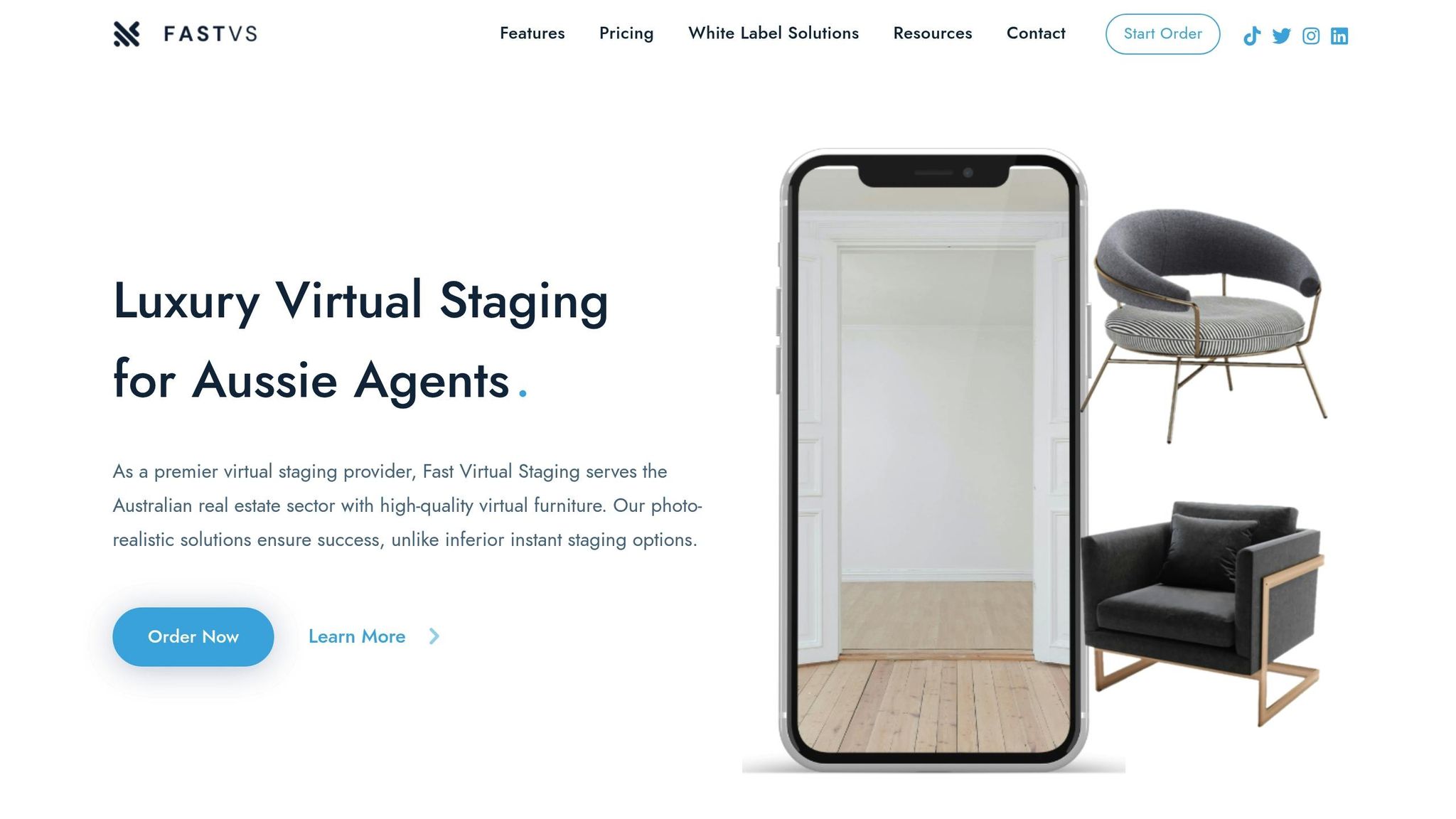
Fast Virtual Staging provides Australian real estate professionals with a quick and budget-friendly way to stage properties, helping to elevate listings and attract potential buyers.
Main Features and Services
Fast Virtual Staging offers photorealistic staging for both residential and commercial properties, paired with customisable design options that allow agents to create visually striking spaces. One standout feature is its 24-hour delivery guarantee, a lifesaver for agents working under tight deadlines. At just $30 AUD per image, the service is priced to suit the Australian market [website]. Each order also includes two free revisions, ensuring the final product meets expectations. Additionally, white-label solutions are available, making it an attractive option for real estate photographers and larger agencies.
Agents from leading agencies like Ray White and LINK Property Management have reported increased interest in their listings thanks to the service’s fast turnaround and high-quality staging. These offerings are designed to meet the fast-paced demands of Australia’s competitive property market.
Meeting Australian Market Needs
Fast Virtual Staging is tailored to the unique needs of the Australian market. With 81% of buyer’s agents stating that staging helps buyers envision their ideal living space, the service’s customisation options allow agents to adjust furniture and décor to suit a wide range of tastes. This helps transform empty spaces into inviting, aspirational homes.
Transparency is another focus. The service promotes standardised, clear visuals across platforms and encourages agents to disclose when images have been virtually staged. Its flexibility also allows agents to experiment with different furniture styles, colour schemes, and décor without the cost or hassle of physical staging. Properties that utilise virtual staging often attract up to 60% more views, sell faster, and can command higher prices, making it a smart tool for Australian agents.
Key Takeaways for Australian Property Professionals
Virtual staging has reshaped the property market, helping homes sell faster and often for higher prices. Research shows that staged homes sell 73% faster than vacant ones, and 84% of staged properties achieve or exceed their asking price. Additionally, listings with high-quality photos attract up to 60% more views.
Well-crafted images can also boost the final sale price by 5–10%. Compared to the hefty cost of traditional staging – ranging from A$1,500 to A$10,000 or more – virtual staging offers a budget-friendly yet highly effective solution for agents across all market tiers.
Best Practices for Virtual Staging
Be upfront and transparent. Always disclose the use of virtual staging and provide both original and staged images to maintain trust.
"Most buyers find it hard to visualise an empty room and ‘see themselves in it’, so these edits can really become a silent salesman for your property."
– Brad Filliponi, Co-Founder, Box Brownie
Tailor the staging to fit the local market. Choose furniture and decor that complement the property’s architecture and suit the target audience. For instance, a sleek, modern look might work for a Melbourne CBD apartment, while a family home in Brisbane’s suburbs may call for a cosier, more practical style.
"Virtual staging shows people what the potential of the empty space is. This, in turn, will create a desire to want to live there or own it and ultimately increase the value and or competition on the property, explains Stephen Mutton. It works much like a car that you wouldn’t sell without washing it and showing its full potential."
– Stephen Mutton, LJ Hooker
Use staging to highlight standout features like fireplaces, bay windows, or unique architectural elements. Thoughtful furniture placement can draw attention to these details. You can also demonstrate room versatility – for example, turning a spare room into a home office or a nursery to appeal to specific buyer demographics.
These strategies underscore virtual staging’s role as a powerful and practical tool for property professionals.
Bottom Line
Virtual staging delivers measurable advantages for Australian property professionals. With 81% of buyers’ agents agreeing that staging helps clients imagine a property as their future home, it’s clear that this technology is more than just a convenience – it’s a game-changing tool.
The benefits are undeniable: faster sales, higher sale prices, and significantly reduced costs compared to traditional staging. Virtual staging also offers unmatched flexibility, letting agents experiment with various design styles without the physical limitations of traditional methods. And with properties often staged within 24–48 hours, the process keeps pace with the fast-moving property market.
For agents aiming to maximise their listings, virtual staging isn’t just about filling empty rooms – it’s about creating an emotional connection that turns casual browsers into committed buyers, ensuring properties stand out in an increasingly competitive landscape.
FAQs
Is virtual staging more cost-effective than traditional staging for selling homes?
Virtual staging offers a budget-friendly alternative to traditional staging, delivering an impressive return on investment (ROI). Sellers can expect an ROI between 500% and 3,650%, compared to 102% to 909% for traditional methods. Plus, it’s about 97% cheaper, eliminating the need for costly physical furniture or décor.
Beyond the cost savings, virtual staging can help properties sell quicker and often at or above the asking price. By creating realistic, visually appealing images, it draws in more potential buyers, even in highly competitive markets. For Australian sellers aiming to boost their property’s appeal without overspending, virtual staging is a practical and effective solution.
How can I ensure transparency and build trust when using virtual staging in property listings?
To keep things transparent and build trust with potential buyers, it’s important to clearly state when images have been virtually staged. You can do this by adding a straightforward disclaimer in the listing description.
If you can, include before and after images. This gives buyers a clear picture of the property’s actual condition alongside the staged version. Also, make sure the virtual staging reflects the property accurately – don’t misrepresent structural features or cover up any major issues. Being upfront and clear not only builds credibility but also helps buyers feel more confident about your listings.
How can virtual staging be tailored to attract different types of buyers and boost property appeal?
Virtual staging offers a creative way to connect with different buyer groups by using design styles that match their tastes. For instance, sleek, minimalist interiors might catch the eye of young professionals, while cosy, family-friendly designs could draw in buyers with children. Showcasing standout features like open-plan layouts or inviting outdoor areas can also make a property more appealing to specific audiences.
Real estate agents can take this a step further by using data and insights into buyer behaviour to tailor virtual furniture and décor to current market trends. Being upfront about the use of virtual staging not only builds trust but also highlights the property’s potential. This helps buyers imagine themselves in the space, giving the property an edge in Australia’s highly competitive real estate market.