
AI-powered virtual staging is transforming the Australian real estate market by making property marketing faster, cheaper, and more efficient. Here’s what you need to know:
- Faster Results: Traditional staging takes 1–2 weeks, while AI can stage photos in seconds, helping homes sell 73% faster.
- Lower Costs: AI staging costs as little as A$0.27 per image compared to A$24–A$100 per photo for manual staging or thousands for physical staging.
- Better Engagement: Virtually staged homes see up to 87% more views, increasing buyer interest and reducing listing times.
- Advanced Features: AI tools offer one-click furniture placement, automatic lighting adjustments, and consistent design across multiple photos.
- Local Appeal: Platforms cater to Australian tastes with styles like Scandinavian or Modern, ensuring listings resonate with buyers.
AI staging is ideal for agents managing multiple listings, offering quick turnarounds and polished results that make properties stand out in a competitive market. With AI, you can stage more homes, attract more buyers, and close sales faster – all while saving time and money.
Key AI Automation Features in Virtual Staging
One-Click Furniture Placement and Background Removal
AI-powered virtual staging has revolutionised how real estate photos are enhanced. Using machine learning, these tools can digitally add furniture and decor into listing photos with impressive precision, identifying key room features and overlaying matching 3D elements in just seconds.
This one-click functionality is a standout feature. Users can upload photos of furnished rooms and select the "Remove Furniture" option, allowing the AI to declutter the image automatically. For empty spaces, the AI places furniture instantly, tailoring it to the room’s dimensions and layout. What used to take days can now be done in moments, delivering professional-quality results.
The results speak for themselves – listings with virtual staging can experience up to an 87% boost in views. This surge in interest comes from the AI’s ability to help potential buyers imagine a property’s possibilities without the hassle and costs of traditional staging methods like furniture rentals and movers. For the best results, high-quality, well-lit photos provide the AI with the details needed to create realistic and appealing virtual staging.
Automatic Lighting, Shadows, and Size Adjustments
What makes AI virtual staging stand out from basic photo editing tools is its ability to create lifelike lighting and shadow effects. By analysing the room’s existing light sources, the AI replicates natural lighting conditions, adding realistic shadows and highlights that seamlessly integrate virtual furnishings into the space.
"Even a beautiful room can look dull if it’s too dark or washed out. Maybe you took the picture on a cloudy day, or the room didn’t get enough natural light. AI tools can instantly fix that."
– Chris Hall, Owner of North Lake Tahoe Cleaning
AI also corrects lens distortions, ensuring vertical and horizontal lines are properly aligned for a balanced image. It enhances sharpness, reduces noise in low-light photos, and adjusts colours to maintain a natural appearance, even transforming smartphone pictures into professional-grade images. These tools can cut editing time by up to 70% and improve workflow efficiency by 50%.
"When your photos look level and balanced, it gives a better sense of space and makes the home feel more organized and well-built – even if the original photo was just a little off."
– Aram Manukyan, Founder & CEO of Sceyt
Building on these improvements, AI now ensures a unified and polished staging style across different photos of the same property.
Style Matching Across Multiple Property Views
AI has taken virtual staging a step further by ensuring consistent design across multiple angles of the same room. Traditionally, maintaining design flow between photos was a challenge, but AI tools now offer multi-view staging capabilities. Users can upload several images of a room from different perspectives, and the AI intelligently matches furnishings and styles to ensure a cohesive look. This creates a seamless visual experience that appeals to high-end buyers.
"The multi-angle staging feature blew us away. We uploaded four different angles of a living room, and the AI matched the furniture placement perfectly in each one. It gives our listings a polished, magazine-quality look."
– Amanda Ruiz, Skyline Property Group
"Consistency across photos really matters in high-end property marketing. This tool made it easy to stage a large open-plan space from different angles without breaking design flow."
– Lena Patel, Crestview Homes
Haus & Grund Immobilien reported that this seamless angle matching significantly boosted engagement on their listings, particularly for virtual walkthroughs.
Step-by-Step Guide to AI-Powered Virtual Staging
Uploading Property Photos
Start by uploading your property photos to the staging platform. Most AI staging tools accept popular file formats like JPG, JPEG, and PNG.
"Upload a high-quality image of an empty room. File types supported: JPG, JPEG, and PNG" – VirtualStaging.art
Using high-resolution images is key, as they give the AI more detail to work with, resulting in more realistic furniture placement and lighting effects. Ensure the rooms are clean and take photos from multiple angles to provide flexibility in staging options and create a cohesive look across all views. Wide-angle shots with good lighting are ideal for capturing room dimensions and boundaries clearly. The better the quality of your photos, the more precise and efficient the staging process will be.
Automated Staging Process
Once the photos are uploaded, the AI gets to work. The process is impressively fast, often completing staging in about 30 seconds.
The AI begins by analysing the room’s dimensions, lighting, and layout to determine the best furniture placement. It identifies key architectural features like windows, doors, and built-ins, which influence how the space is staged.
One of the standout features is the ability to choose from various design styles tailored to your target audience. Whether you’re aiming for a sleek, modern look to attract young professionals or a more traditional design for families, the AI can adapt the staging accordingly. It also enhances the lighting and overall clarity of the image, ensuring the final output is polished and professional-grade.
Cost-wise, AI staging is a game-changer. Some platforms offer unlimited staging for about A$35 per month, while others charge as little as A$0.27 per image. Compare this to traditional staging, which can cost around A$30 per photo and take up to 48 hours to complete. The affordability and speed of AI-powered staging make it an attractive option for property marketers.
Reviewing and Finalising Staged Images
Once the staging is complete, it’s time to review and finalise the images. Most platforms provide multiple staging options for each photo, giving you the flexibility to select the version that aligns best with your marketing goals. If the initial options don’t meet your expectations, many services allow you to generate additional variations without extra charges.
In May 2024, property marketing expert Sharon Lord tested VirtualStagingAI and praised its efficiency. She uploaded photos and received staged images in under a minute, highlighting the platform’s unlimited downloads and renders for each uploaded photo. This feature allows you to experiment with different designs and offer clients a range of options without added costs.
Before finalising, use the platform’s tools to tweak furniture placement or adjust design details like colours and textures. Whether it’s a minor adjustment or a complete overhaul, these tools help you tailor the staging to appeal directly to your target buyers.
It’s important to disclose virtual staging in property listings to maintain transparency and build trust with potential buyers. This honesty helps manage expectations and avoids disappointment during in-person inspections.
Using high-quality AI software ensures the staged images are photorealistic and proportionally accurate, helping buyers envision the space’s potential while keeping their expectations grounded. The ultimate goal is to make it easier for buyers to imagine themselves in the property while staying true to its actual features.
Time-Saving Tips and Best Practices
Batch Processing and Template Styles
Want to speed up your virtual staging process? Batch processing is your answer. By handling multiple property photos at once, you can maintain a consistent design across entire portfolios while cutting down on time spent editing.
Another handy tool is template styles. These are pre-designed layouts and décor schemes that can be instantly applied to any property photo. They eliminate the guesswork from styling and ensure a cohesive look across all your listings. For Australian properties, consider using templates that reflect popular local trends like coastal vibes, sleek contemporary designs, or minimalist aesthetics.
Thanks to AI staging, the turnaround time for a single photo drops from days to just about 15 seconds. For agencies dealing with high volumes, this means you can stage more properties without incurring additional costs or delays. It’s a game-changer for scaling up your operations while keeping things efficient.
White-Label Solutions for Real Estate Teams
White-label virtual staging solutions are a smart way for real estate teams in Australia to strengthen their brand. These solutions let you offer staging services under your own company name, blending seamlessly with your existing processes.
Look for options that provide custom branding, multi-user management, and easy integration with your current systems. These features help teams juggle multiple projects efficiently while maintaining a polished, professional image. Plus, this approach can significantly reduce costs and enhance client satisfaction – all without the need for an in-house design team.
Adding a well-organised design style library takes this efficiency to the next level.
Building a Design Style Library
A design style library is like your secret weapon for faster workflows. This collection should include your go-to room styles, furniture sets, and décor elements that can be reused across projects. Instead of starting from scratch every time, you’ll have a reliable toolkit that ensures consistent quality.
Keep your library updated to reflect current market trends and buyer preferences. This way, your staging remains fresh and appealing to clients. Teams that maintain an evolving library often report quicker turnarounds and happier clients, as this approach not only simplifies the process but also guarantees predictable, high-quality results.
Fast Virtual Staging offers Australian real estate professionals the tools they need to deliver stunning, photo-realistic renders with quick turnarounds and designs tailored specifically to local tastes.
sbb-itb-f3f2f9e
Ultra Fast Staging: Virtual Staging AI
Traditional vs AI-Powered Virtual Staging Comparison
The move towards AI-powered virtual staging is reshaping how real estate marketing operates. This comparison not only sheds light on performance metrics but also highlights the practical benefits for real estate professionals juggling busy schedules.
Traditional virtual staging involves human designers meticulously placing furniture and décor into property photos. This process requires detailed communication between agents and designers, multiple rounds of revisions, and a tailored approach to each project. While this method offers a high level of personalisation, it often comes with steep costs and longer turnaround times.
On the other hand, AI-powered virtual staging uses advanced algorithms to analyse property features and target demographics. These algorithms then suggest furniture layouts and design options intelligently. By automating much of the process, AI reduces manual effort, minimises errors, and still delivers professional-grade results.
The real distinction between these methods lies in the speed and cost at which results are achieved.
Key Metrics: Speed, Cost, Scale, and Design Consistency
When we break it down, the differences in performance become evident, especially in areas crucial to Australian real estate professionals:
- Speed: Traditional virtual staging often takes 1–2 weeks to produce final images. Manual virtual staging speeds this up to around 24–48 hours per photo. Meanwhile, AI-powered staging can generate results in mere seconds, enabling agents to stage entire property portfolios in minutes.
- Cost: Physical staging for larger properties can cost anywhere between AU$2,000 and AU$5,000+, with additional monthly furniture rental fees of AU$500–AU$600 per room. Manual virtual staging is more affordable, ranging from AU$24 to AU$100 per photo. AI virtual staging, however, is far more economical, with prices starting as low as AU$0.47 per image and subscription plans beginning at AU$14 for 30 credits.
Here’s a quick comparison of the two approaches:
| Features | Traditional Virtual Staging | AI Virtual Staging |
|---|---|---|
| Customisation | Tailored by a professional | Quickly explores styles with AI |
| Speed | Time-intensive due to manual input | Rapid delivery of results |
| Cost | Higher due to designer expertise | Budget-friendly for sellers |
| Scalability | Limited by designer capacity | Handles large volumes with ease |
AI staging stands out by offering unmatched speed, affordability, and scalability – making it a game-changer for the Australian property market. While traditional methods are constrained by the availability and time of designers, AI can efficiently process high volumes of images, which is ideal for time-pressed real estate agents.
Another key difference is design consistency. Traditional staging often varies based on a designer’s interpretation, while AI ensures a uniform look across projects. Interestingly, around 65% of interior designers now use AI tools, citing improved efficiency and a boost in creative possibilities.
AI-powered staging also provides creative flexibility. With access to pre-set styles and the ability to generate multiple design options quickly, agents can experiment with layouts and aesthetics without extra costs or delays. This adaptability allows them to respond swiftly to changing buyer preferences and market trends.
For Australian agents, these advantages translate into real value. For the cost of a single traditionally staged image, they can stage an entire home’s photo set using AI, leading to faster listings and the ability to serve more clients efficiently.
Fast Virtual Staging caters specifically to the Australian market, offering photo-realistic renders that combine speed, affordability, and consistent quality – meeting the expectations of local buyers with ease.
The Future of Virtual Staging in Australia
Virtual staging in Australia is on the rise, with forecasts predicting the market will grow from AU$1.5 billion in 2024 to AU$4.7 billion by 2033. That’s an impressive annual growth rate of 13.8%. This evolution is transforming how real estate professionals market properties and engage with potential buyers.
How AI Enhances Efficiency and Results
AI technology is proving to be more than just a cost-effective tool – it’s delivering real, measurable results. For instance, AI-powered virtual staging can increase buyer inquiries by up to 50% and boost the likelihood of scheduled viewings by 32%.
The impact is even more striking when you look at real-world examples. Coldwell Banker reported that properties sold 73% faster when virtually staged, with listing times dropping from 90 days to just 24. Additionally, these properties attracted 74% more in-person showings. Similarly, Century 21 found that first offers came in 62% faster for staged homes, helping sellers save significant amounts on monthly holding costs.
For high-end properties, the benefits are even greater. AI staging can add an 8–12% price premium, which translates to an extra AU$80,000–AU$120,000 for a AU$3,000–AU$4,000 investment in staging.
The technology is also evolving to include augmented reality (AR), offering immersive 360-degree tours and personalised designs tailored to buyer personas. Whether it’s luxurious furniture for premium homes or sleek, minimalist décor for first-time buyers, AI tools are helping agents deliver tailored experiences. As AR and virtual reality (VR) become more integrated into these platforms, potential buyers will be able to visualise themselves in staged spaces more vividly, even before stepping foot inside a property.
Fast Virtual Staging: Tailored Solutions for Australian Real Estate
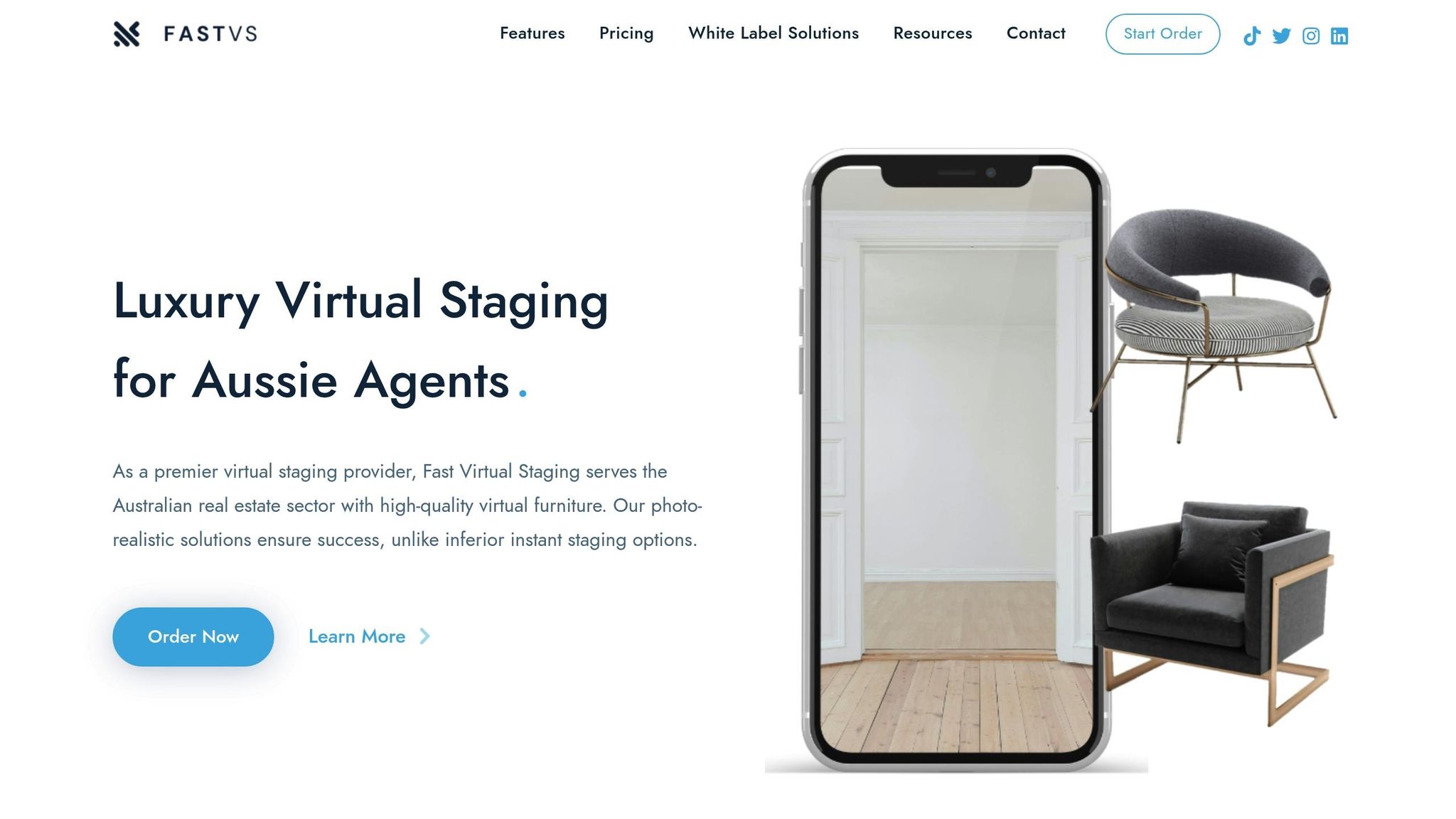
The growing demand for virtual staging highlights the need for fast, reliable solutions tailored to the Australian market. Fast Virtual Staging offers photo-realistic digital furniture renders for both residential and commercial properties. With a guaranteed 24-hour turnaround for residential projects, agents can act quickly to seize market opportunities.
Their platform caters to local preferences, offering customisable design styles like Scandinavian and Modern aesthetics that resonate with Australian buyers. They also provide white-label options for real estate photographers and platforms, ensuring seamless integration into existing workflows. At just AU$30 per image, the service includes an account manager and two complimentary revisions, making it an accessible option for agents across different market segments.
As Australia’s AI market is projected to hit AU$315 billion by 2028, adopting AI-powered staging tools will become crucial for staying competitive. By combining cutting-edge technology with a deep understanding of local market dynamics, Australian agents are well-positioned to thrive in this digital shift, delivering exceptional outcomes for their clients.
"We are poised to lead, provided we continue to innovate and scale up our AI capabilities strategically."
– Damian Kassabgi, Chief Executive Officer, Tech Council of Australia
FAQs
How does AI help create virtually staged homes that appeal to Australian buyers?
AI has become an essential tool in creating virtually staged homes that suit Australian design tastes, delivering flexible and lifelike solutions. It tailors furniture styles, colour palettes, and layouts to reflect popular local aesthetics like modern simplicity, minimalist elegance, or the laid-back charm of coastal designs.
These tools also take into account regional preferences and local trends, ensuring the staging feels relatable to Australian buyers. By weaving in familiar design elements and crafting visually inviting spaces, AI helps foster a stronger emotional connection with potential buyers, making properties more appealing and ready for the market.
What are the advantages of using AI-powered virtual staging for real estate agents?
AI-powered virtual staging has transformed how real estate agents market properties, offering a faster and more cost-effective alternative to traditional staging. With this technology, properties can be virtually staged in as little as 30 seconds or within a few days, allowing agents to list homes quickly and keep up with the fast-paced property market.
The images created through AI staging are incredibly realistic, helping potential buyers picture how a space could look and function. This improved visual appeal often sparks greater buyer interest, which can lead to quicker sales. By simplifying processes and elevating the quality of property presentations, AI virtual staging has become a must-have tool for real estate professionals across Australia.
How does AI improve lighting and shadows to create realistic virtually staged photos?
AI takes virtual staging to the next level by refining lighting and shadows in photos. It carefully examines natural light sources and how they interact with objects in the space. Then, it fine-tunes elements like brightness, contrast, and shadow placement so that digital furniture and decor look like they truly belong in the room.
The result? A realistic, polished image that feels natural and visually inviting. This automated process not only saves time but also ensures real estate professionals get consistently high-quality images every time.