
Virtual staging is transforming the way Australian real estate agents market properties. By digitally furnishing empty or sparsely decorated homes, agents can create visually appealing listings without the high costs or logistical challenges of physical staging. Here’s what you need to know:
- Cost-Effective: Virtual staging costs between AUD 30–120 per image, compared to AUD 1,500–10,000+ for physical staging.
- Fast Turnaround: Images can be ready in 12–48 hours, or even minutes using AI tools.
- Customisable Designs: Agents can showcase multiple styles for the same space, catering to different buyer demographics.
- Increased Buyer Interest: High-quality staged images attract up to 60% more views, with staged homes often selling for 5–10% more.
- Ideal for Online Listings: With 90% of property searches starting online, visually compelling images are critical.
Agents can leverage virtual staging to present properties in the best light, appeal to local and international buyers, and close sales faster. The process is straightforward, affordable, and highly effective in Australia’s competitive real estate market.
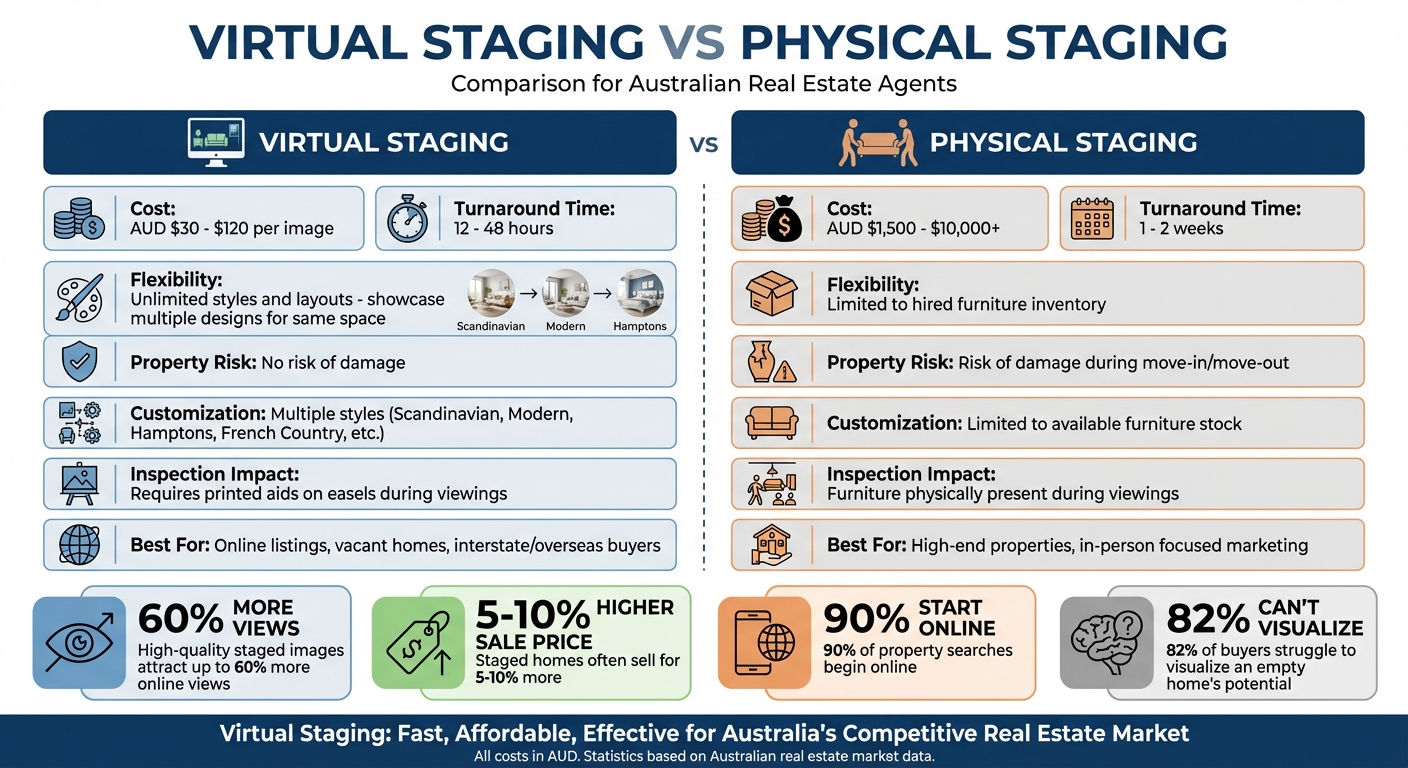
Virtual Staging vs Physical Staging: Cost, Time and Benefits Comparison for Australian Real Estate
What Virtual Staging Is and How It Works
Defining Virtual Staging
Virtual staging uses computer-generated imagery or AI to add life-like furniture, decor, and other elements to property photos. It starts with taking pictures of an empty or sparsely furnished home, then digitally enhancing them to showcase the space’s possibilities. Unlike traditional staging, this process skips the hassle of renting furniture, arranging deliveries, or managing logistics.
The process is straightforward: high-quality images of the property are uploaded to a staging platform. Real estate agents can select from a variety of design styles – like Scandinavian, Modern, or Hamptons – that align with the preferences of their target audience. From there, skilled 3D artists or AI tools add virtual furniture and decor, ensuring the proportions, lighting, and shadows look natural. The final images are typically ready within 12 to 48 hours, delivered through a downloadable link. One standout feature of virtual staging is its ability to present multiple layouts or styles for the same space, catering to different buyer tastes. This is particularly helpful since 82% of buyers struggle to visualise an empty home’s potential.
"It is the best way to bring a cold vacant home to life easily. It helps to show its full potential."
- Brad Filliponi, Co-Founder, Box Brownie
This method not only provides realistic and engaging visuals but also offers advantages in terms of cost, speed, and adaptability.
Main Benefits for Australian Real Estate Agents
Virtual staging offers distinct advantages that are especially valuable in Australia’s competitive property market.
One key benefit is affordability. Traditional staging can cost anywhere from AUD 1,500 to over AUD 10,000, while virtual staging is significantly cheaper, ranging from AUD 30 to AUD 120 per image. Some AI-based options are even more budget-friendly, starting at just AUD 10 per room.
Another major advantage is speed. Physical staging often takes a week or more due to the need for consultations, deliveries, and setup. In contrast, virtually staged images are usually ready within 12 to 48 hours – and some AI services deliver results in mere minutes.
Virtual staging also excels in flexibility and scalability. Without the need for physical furniture or movers, there’s no risk of property damage during staging. Plus, agents can tailor designs to suit the location and style of a property. For instance, coastal tones might be used for beachside homes, while industrial designs could highlight the appeal of inner-city apartments. This personalisation helps create an emotional connection with potential buyers.
"Virtual staging shows people what the potential of the empty space is. This, in turn, will create a desire to want to live there or own it and ultimately increase the value."
- Stephen Mutton, National Head of Network Development, LJ Hooker
How to Use Virtual Staging to Win Listings
Step 1: Choose Properties That Need Virtual Staging
Not every property benefits from virtual staging, but certain types stand out as ideal candidates. Vacant homes are a prime example – empty rooms can feel unwelcoming and make it hard for buyers to visualise the space’s potential. A well-staged online listing creates a powerful first impression.
Small or oddly shaped spaces also gain a lot from virtual staging. Think of compact apartments or terrace homes in urban areas. These spaces can be transformed by showing how furniture fits and flows. Multi-purpose rooms, like a small bedroom styled as both an office and nursery, can highlight versatility for different buyers.
Entry-level properties are another great fit since physical staging costs – ranging from $1,500 to over $10,000 – can eat into profits. Virtual staging offers a cost-effective alternative. Similarly, homes targeting interstate or overseas buyers, such as student accommodation or luxury holiday homes, benefit from polished digital presentations. Around 25% of views on some Australian listings come from interstate, and 10% come from overseas.
Don’t forget about commercial properties. Empty office spaces, retail outlets, or industrial units can be virtually furnished to help potential tenants or investors picture how the space might work for their needs.
Once you’ve identified the right properties, the next step is to align the design with local buyer preferences.
Step 2: Select Design Styles That Match Local Buyer Preferences
Tailoring the design style to the property’s location and target audience is key. Match the style to the neighbourhood – coastal tones are perfect for beachside suburbs, while industrial aesthetics suit inner-city properties.
Think about the demographics you’re targeting. For example, younger urban buyers might prefer sleek, minimalist designs, while suburban families often gravitate toward cosy, traditional setups. Avoid overly trendy or niche furniture that could alienate potential buyers.
"Styling has to highlight the features of the property without alienating anyone. Whether it’s a family home, a city unit, or a downsizer’s retreat, the goal is to make the home aspirational and functional"
- Justine Wilson, Director, Vault Interiors
For smaller properties, consider using space-saving and multi-functional furniture to show how to make the most of limited space. This approach is particularly effective in Australia’s high-density urban areas, where buyers prioritise practicality alongside style.
To appeal to a broader audience, you can even present the same room in different layouts or styles. This not only showcases flexibility but also helps connect with a range of buyer preferences.
Step 3: Upload Photos and Customise with Fast Virtual Staging

The process is straightforward. Start by taking high-quality photos with proper lighting and angles. Upload these images to Fast Virtual Staging’s platform, which offers a range of design options like Scandinavian, Modern, or French Country styles. With a 12–24 hour turnaround, the platform ensures your property images are ready to impress. The service costs $30 AUD per image and includes an account manager to guide you through the process.
You can customise the designs to fit the property and target market. For instance, a coastal home in Queensland might feature light, airy furniture with beach-inspired tones.
Fast Virtual Staging handles both indoor and outdoor spaces, so don’t stop at the living room or bedroom. Virtually stage balconies, patios, and small gardens to emphasise lifestyle appeal. Skilled 3D artists ensure the virtual furniture looks natural, with accurate proportions, lighting, and shadows.
Need changes? The service includes two free revisions, so you can tweak the images until they meet your expectations. Once your customised images are ready, you’re set to present them to sellers.
Step 4: Present Staged Photos to Sellers
When pitching virtual staging to sellers, use before-and-after comparisons. Showing an empty room next to its staged version makes the impact obvious and highlights the value.
Emphasise the cost and speed benefits. While physical staging can cost thousands and take weeks, virtual staging delivers professional results for a few hundred dollars in just 12–24 hours.
"The clear value proposition of virtual staging is the upfront cost. Physical staging can cost an owner several thousand dollars. Virtual staging can be delivered for a few hundred"
- Jacob Caine, President, Real Estate Institute of Australia
| Feature | Virtual Staging | Physical Staging |
|---|---|---|
| Cost | $30 – $120 per image | $1,500 – $10,000+ |
| Turnaround | 12 – 48 hours | 1 – 2 weeks |
| Flexibility | Unlimited styles and layouts | Limited to hired inventory |
| Risk | No property damage | Risk of damage during move-in |
| Inspection Impact | Requires printed aids (easels) | Furniture physically present |
Address the inspection challenge early. While virtual staging creates stunning online images, buyers will still encounter empty rooms during in-person inspections. To bridge this gap, print the staged images and display them on easels in the corresponding rooms. This helps buyers visualise the potential as they walk through.
Lastly, be transparent about disclosure. Clearly label virtually staged images to build trust and comply with Australian consumer protection laws. This approach not only enhances your listings but also strengthens your reputation in the competitive real estate market.
Virtual Staging Your Real Estate VIDEO Is SO EASY
sbb-itb-f3f2f9e
Adding Virtually Staged Images to Australian Property Listings
When you’ve decided to include virtually staged images in your property listings, it’s crucial to integrate them thoughtfully. This not only ensures compliance with consumer laws but also builds trust with potential buyers.
Using Staged Images on Domain and Realestate.com.au
Uploading virtually staged images to platforms like Domain and Realestate.com.au is a simple process, but transparency is key. To comply with Australian consumer protection laws, always label these images with a watermark or caption such as "Virtually Staged". This helps buyers clearly differentiate between the staged visuals and the actual property layout.
"There are really strict laws in Australia about misleading advertising that you could unwittingly fall foul of." – Suzi Buckley, Buyer’s Agent, Cohen Handler
Virtual staging should focus on adding furniture and decor while keeping room proportions accurate. Professional staging services often measure spaces digitally to ensure the furniture is scaled correctly. To further enhance clarity, include detailed floor plans alongside staged images, allowing buyers to cross-check the layout and dimensions.
Here’s why this matters: listings with high-quality photos get up to 60% more views, and 85% of buyers say listing images influence their decision to inspect a property. Considering that 90% of property searches begin online, your staged images are often the first impression – and they need to be both visually appealing and trustworthy.
Including Metric Measurements and AUD Pricing
Accurate details, like metric measurements and AUD pricing, are essential to reinforce the credibility of your listings. Australian buyers expect room dimensions to be provided in metres, either in the property description or on the floor plan. This ensures the virtual staging aligns with reality, avoiding any confusion about the true size of the space.
It’s important not to manipulate furniture scaling to make rooms appear larger than they are. Always include precise dimensions – for example, "Master bedroom: 4.2m x 3.8m" – to give buyers an honest representation of the property.
When it comes to pricing, list the amount clearly in AUD, whether it’s a sale price (e.g., $850,000) or weekly rental cost (e.g., $650 per week). By combining accurate pricing with staged images and measurements, you enable buyers to make informed decisions without feeling misled.
"If a client turns up to physically inspect a property and realises it’s quite different to the images, it’s game over." – Suzi Buckley, Buyer’s Agent, Cohen Handler
This level of detail is particularly important for interstate and overseas buyers, who can make up 25% and 10% of viewers, respectively, for some Australian listings. Since these buyers often rely solely on online information before deciding to visit, your digital presentation must be clear, accurate, and inviting.
Results: Virtual Staging Success Stories in Australia
Effect on Sales Speed and Property Value
Recent figures from Victorian property listings highlight how virtual staging can significantly speed up sales and boost property values. A detailed analysis of 115,000 listings in Victoria found that homes marketed as "interior-designed" sold for 7% to 8% more than similar properties without styling. In Melbourne’s CBD, styled three-bedroom apartments saw an average price increase of 15.83% – equating to approximately $200,745. For family homes, the benefits were equally impressive, with three-bedroom houses achieving a 7.54% premium (an extra $71,258) and four-bedroom homes recording a 6.99% boost (adding $95,236).
"I’ve taken over homes that sat on the market for 120 days. We repainted, staged properly, added warmth and colour, and sold them within weeks." – Alejandro Torres, Associate Director, James Nicolaou Real Estate
Virtual staging has proven especially effective for relaunching properties that have been on the market for extended periods. Homes that struggled to sell – even after 120 days – often find buyers within weeks after being visually transformed with staged imagery. The process is also fast: virtual staging offers a 48-hour turnaround, a stark contrast to the week or more required for traditional physical staging.
These results underscore how virtual staging not only adds financial value but also helps listings stand out in crowded markets.
Standing Out in High-Demand Markets
In Australia’s most competitive suburbs, virtual staging does more than just raise prices – it helps properties shine. For example, in Brighton, four-bedroom homes achieved an 11.70% price premium, adding $445,200 to their sale prices. Fitzroy’s three-bedroom homes saw an even bigger jump, with a 14.00% increase, equating to $256,642. Meanwhile, Brunswick’s three-bedroom properties enjoyed a 10.60% premium, adding $134,978.
"Buyers are drawn to homes that feel light, spacious and ready to live in, that emotional response is what pushes them to bid higher." – Cayley Scrooby, Expert Stylist, Sovereign Interiors
This emotional appeal is a key driver of buyer behaviour. Staged imagery creates a sense of warmth and readiness that resonates with potential buyers, encouraging higher bids. This advantage is especially crucial for attracting interstate buyers, who make up 25% of viewers, and overseas buyers, accounting for 10%, as these groups often rely solely on digital visuals before deciding to inspect.
Conclusion
Virtual staging has become a game-changer for Australian real estate agents aiming to secure more listings and stand out in highly competitive markets. Professionally staged images grab buyer attention instantly, and the numbers back it up – properties with virtual staging typically sell for 5% to 10% more on average.
Fast Virtual Staging delivers quick, cost-effective, and high-quality staging solutions. With its fast turnaround times and affordability, agents can list properties sooner and cater to a wide range of buyer preferences.
The benefits go beyond aesthetics. Virtual staging transforms empty spaces into warm, liveable homes, which is especially useful for buyers who rely heavily on online visuals before scheduling inspections. By showcasing this potential to sellers, agents position themselves as forward-thinking professionals who use modern tools to achieve standout results.
"Adding virtual furniture to my property photographs always generates increased interest in my listings. I can choose my own style of furniture and turn‑around times are super‑fast for the quality." – Jack Dangerfield, Real Estate Agent, Ray White
Fast Virtual Staging combines photo-realistic 3D renders, flexible design options, and dedicated account support, making it easy for Australian agents to integrate into their marketing. Whether you’re showcasing a terrace home in Sydney or a luxury apartment in Melbourne, this approach enhances property appeal, speeds up sales, and boosts returns. Incorporating virtual staging into your strategy ensures you remain a forward-thinking, results-focused real estate professional.
FAQs
How can virtual staging help increase the sale price of a property?
Virtual staging is a powerful tool for increasing a property’s sale price by improving its visual appeal and helping buyers picture how the space could work for them. By digitally adding sleek furniture and decor, it creates an emotional connection and showcases the property’s possibilities.
This technique often boosts the perceived value of a home, potentially raising sale prices by 5–20%. For real estate agents in Australia, it’s an affordable way to make listings shine in a competitive market.
What makes virtual staging a better choice than physical staging?
Virtual staging comes with some standout perks compared to traditional physical staging. For starters, it’s much easier on the budget, cutting costs by as much as 97%. Plus, it’s incredibly quick – most projects are ready to go in just 12–24 hours. This means you can start attracting potential buyers almost immediately.
Another big win? Virtual staging offers the flexibility to tailor designs to match what your target audience loves. This customisation can make a property far more enticing. Even better, statistics show that properties with virtual staging can sell up to 73% faster and often fetch prices that are 5–20% higher. It’s a smart move for sellers looking to stand out in a competitive market.
How can real estate agents be transparent when using virtual staging?
To maintain trust, real estate agents should always clearly disclose when images have been virtually staged. This means labelling such images as digitally modified and ensuring potential buyers are fully aware of the enhancements. Being transparent not only builds confidence but also aligns with Australian advertising standards.
By being open about virtual staging, agents can highlight a property’s potential while preserving their reputation and professionalism.