
Virtual staging is transforming Australian real estate marketing. With over 90% of buyers starting their search online, the visual appeal of property listings is crucial. Virtual staging digitally furnishes empty spaces, helping buyers visualise a property’s potential. It’s cost-effective, quick, and avoids the logistical challenges of physical staging.
Key takeaways:
- Apartments: Ideal for showcasing compact, functional layouts. Popular with remote buyers (35% interstate/overseas). Staging costs start at $10 per image, with a potential 5–15% price uplift.
- Houses: Focuses on creating an emotional connection by defining larger spaces. Appeals to families and upsizers. Costs are similar, with a similar price uplift.
Quick Comparison
| Feature | Apartments | Houses |
|---|---|---|
| Buyer Demographics | Young professionals, investors | Families, upsizers |
| Staging Focus | Space efficiency, modern style | Lifestyle, emotional appeal |
| Price Uplift | 5–15% | 5–15% |
| Logistical Advantage | High (avoids furniture delivery) | Moderate |
| Remote Buyer Appeal | High (35% interstate/overseas) | Moderate to high |
Virtual staging is a practical tool for both apartments and houses, helping properties stand out online and driving higher conversions.
Virtual Staging for Apartments in Australia
Marketing apartments comes with its own set of challenges. From coordinating tradespeople for high-rise deliveries to showcasing compact spaces effectively, the process can get tricky. This is where virtual staging steps in, offering a practical way to help buyers visualise the potential of smaller areas. It’s particularly effective in demonstrating how to make the most of limited space, which is crucial for apartment buyers.
Design Styles and Features for Apartments
When it comes to apartment staging, modern and minimalist designs tend to steal the show. Young professionals – one of the key buyer groups – are drawn to clean lines, contemporary aesthetics, and industrial elements that align with urban lifestyles . Another common hurdle for buyers is imagining how furniture fits into smaller spaces. Virtual staging can solve this by showcasing practical layouts, like turning a small bedroom into a dual-purpose area for sleep and work or transforming an unused corner into a functional study nook .
Virtual staging also allows flexibility. A single room can be presented in multiple ways – imagine showing a second bedroom as either a nursery or a home office. For apartments with balconies or small outdoor areas, staging these as cosy retreats or entertaining spaces can significantly boost their appeal.
Apartment Buyer Demographics and Preferences
Apartment buyers in Australia generally fall into three main groups: young professionals, investors, and downsizers. Each group has its own priorities. Young professionals want stylish, functional spaces; investors focus on rental appeal and low-maintenance designs; and downsizers often look for comfort and practicality. Virtual staging plays a critical role here, especially since a significant portion of buyers – 25% interstate and 10% overseas – rely on online listings.
The financial impact of virtual staging can be impressive. It has been shown to increase selling prices by 5% to 15%, which on a $700,000 apartment translates to a boost of $35,000 to $105,000. However, there’s a catch: the staged images must align with the actual property. As buyer’s agent Suzi Buckley puts it:
"If a client turns up to physically inspect a property and realises it’s quite different to the images, it’s game over".
To bridge this gap, some agents display printed versions of the virtually staged images during inspections. Placed on easels in empty rooms, these visuals help buyers reconnect with the online vision.
Case Study: Apartment Staging with Fast Virtual Staging
Fast Virtual Staging offers a practical and budget-friendly solution for apartment staging, starting at $30 per image with a quick 12–24 hour turnaround. Their service includes a variety of customisable design styles – from Scandinavian to Modern – allowing agents to tailor the look to their target audience. With two free revisions and a dedicated account manager, agents can ensure the final images hit the mark with potential buyers.
While cheaper AI-based staging options are available (as low as $10 per room), they often lack the finesse needed to appeal to discerning buyers. As Maggie Hook from Little Hinges explains:
"The AI is just not smart enough yet. It doesn’t have the human touch that is required to style a property appropriately for its target market".
For agents targeting younger or more selective buyers, investing in human-led staging can make all the difference. It’s an approach that not only enhances the property’s presentation but also boosts engagement and, ultimately, sales.
Virtual Staging for Houses in Australia
Houses in Australia often come with larger spaces and outdoor areas, offering a different staging challenge compared to apartments. While apartments thrive on efficient layouts, houses need to evoke an emotional connection that reflects a lifestyle. Virtual staging plays a key role here, transforming empty rooms into warm, inviting spaces.
Physical staging for a three-bedroom house can cost between $3,000 and $4,500. In contrast, virtual staging achieves similar results within 48 hours and at a fraction of the price .
Design Styles and Features for Houses
Staging a house is less about its square metres and more about showcasing a way of life. For family buyers, traditional and cosy designs often resonate, while younger buyers and professionals may lean towards modern, minimalist aesthetics. Outdoor spaces are also a big draw for houses, and virtual staging can reimagine gardens, patios, and decks as functional outdoor dining or lounge areas.
When dealing with open-plan layouts, virtual staging helps define distinct zones – turning one large area into a lounge, dining space, and sitting nook. However, shrinking furniture to make rooms feel larger can be risky, as it may disappoint buyers during in-person inspections.
House Buyer Demographics and Preferences
Australian house buyers typically fall into two main categories: families and upsizers. Families prioritise functionality, looking for spaces that cater to children, pets, and daily life. They appreciate seeing how a spare room could serve as a nursery or home office and value creative use of every corner, even under-stair spaces.
Upsizers – often moving from apartments or smaller homes – are drawn to properties that offer both spaciousness and comfort. They’re looking for homes that balance aspirational features with practicality.
Virtual staging bridges the gap between an empty house and a home buyers can picture themselves living in. As Brad Filliponi from Box Brownie puts it:
"Most buyers find it hard to visualise an empty room and ‘see themselves in it’, so these edits can really become a silent salesman for your property."
With over 90% of property searches starting online, a visually appealing listing is crucial. Virtual staging helps create that all-important first impression, setting the foundation for buyer interest.
Case Study: House Staging with Fast Virtual Staging
Fast Virtual Staging offers a cost-effective and efficient solution for staging houses. At just $30 per image with a 12–24 hour turnaround, agents can stage multiple rooms without the hassle of organising physical furniture. The service includes a range of design styles, such as Coastal and Scandinavian, enabling tailored presentations for specific buyer demographics.
One successful strategy involves staging a single room in multiple ways. For example, a spare bedroom can be presented as both a nursery and a home office, appealing to different family needs. To address the potential disconnect between online images and physical inspections, some agents display printed versions of virtually staged photos during open homes. This helps buyers reconnect with the possibilities they saw online.
For family homes, where buyers are making both emotional and financial commitments, these thoughtful touches can mean the difference between a quick sale and a listing that lingers on the market.
Apartments vs Houses: Conversion Metrics Comparison
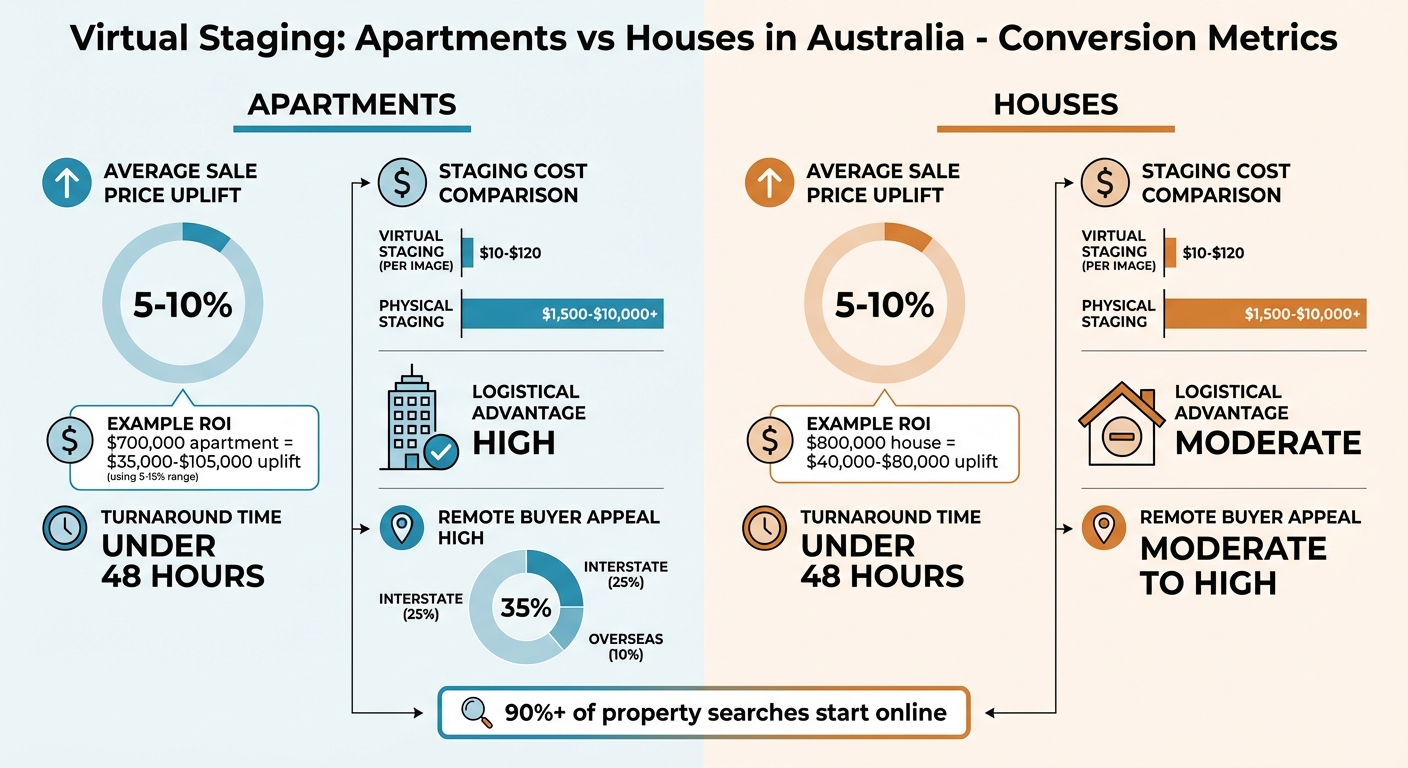
Virtual Staging Apartments vs Houses Australia Conversion Metrics Comparison
The numbers don’t lie – conversion metrics reveal just how impactful virtual staging can be. In Australia, staged properties consistently sell for 5% to 10% more than their unstaged counterparts. This increase applies to both houses and apartments, so, for example, a $600,000 apartment could bring in an extra $30,000 to $60,000, while an $800,000 house might fetch an additional $40,000 to $80,000.
When it comes to logistics and buyer reach, apartments have a clear edge. Virtual staging eliminates the hassle of physically moving furniture into high-rise units. Maggie Hook from Little Hinges puts it perfectly:
"The pros outweigh the cons, particularly for apartments. There’s no furniture hire. There’s no delivery charge. It eliminates the need for high-floor furniture delivery."
Apartments also attract a higher percentage of remote buyers, with about 25% of viewers coming from interstate and 10% from overseas. This makes virtual staging especially effective for listings that rely on online buyers. These factors combine to make apartments particularly well-suited for virtual staging.
Both houses and apartments benefit from virtual staging’s quick turnaround, with images ready in under 48 hours. The cost is another win for virtual staging – ranging from $10 to $120 per image, compared to the hefty price tag of physical staging, which can cost $1,500 to over $10,000.
Apartments vs Houses Conversion Metrics Table
Here’s a snapshot of how apartments and houses compare on key metrics:
| Metric | Apartments | Houses |
|---|---|---|
| Average Sale Price Uplift | 5% to 10% | 5% to 10% |
| Virtual Staging Cost | $10 to $120 per image | $10 to $120 per image |
| Physical Staging Cost | $1,500 to $10,000+ | $1,500 to $10,000+ |
| Turnaround Time | Under 48 hours | Under 48 hours |
| Logistical Advantage | High (avoids high-floor delivery) | Moderate (easier access) |
| Remote Buyer Appeal | High (35% interstate/overseas) | Moderate to High |
sbb-itb-f3f2f9e
How to Optimise Virtual Staging for Australian Real Estate
To make virtual staging work effectively in the Australian property market, it’s essential to match staging styles to the type of property and the preferences of potential buyers. For apartments, focus on sleek, space-efficient designs that cater to urban lifestyles. Scandinavian or contemporary aesthetics often suit inner-city units, while family-friendly layouts with defined living spaces are a better fit for suburban houses. These strategies ensure that the staging aligns with the property’s architecture and the needs of its target audience.
Customising Staging Plans for Apartments and Houses
The approach to staging apartments is different from that for houses. In smaller units, virtual staging can showcase how spaces can serve multiple purposes. For instance, a spare room could be presented as a combination of a nursery and a home office, appealing to a variety of buyer profiles. For houses, staging should focus on defining larger or awkward spaces and creating a natural flow between rooms. Key areas like the living room, master bedroom, kitchen, and bathroom should be prioritised, as these are where buyers often form emotional attachments. This tailored staging strategy helps increase buyer interest by making each property more relatable and functional.
However, it’s crucial to clearly label images as virtually staged. If buyers arrive expecting a certain look and find something entirely different, it could harm their trust and potentially derail the sale.
Fast Virtual Staging Features for Real Estate Professionals
Fast Virtual Staging takes property presentations to the next level with its specialised features. The service employs professional 3D artists to create highly realistic images. Orders are completed within 12 to 24 hours, and residential orders come with a 24-hour delivery guarantee – if they’re late, they’re free. Clients also benefit from an assigned account manager and two complimentary revisions to ensure the staging perfectly aligns with expectations.
The platform offers a variety of interior design styles, including Scandinavian, Modern, and French Country, and allows for custom briefs to match the unique character of each property. It also extends its services to outdoor spaces like patios and balconies, which is ideal for highlighting the Australian lifestyle without the cost of physical outdoor furniture. Additionally, real estate photographers can take advantage of white-label solutions with a 20% discount, simplifying the integration of staging into their service packages.
Fast Virtual Staging Plan Overview Table
| Feature | Fast Virtual Staging Plan |
|---|---|
| Price | $30 AUD per image |
| Turnaround Time | 12–24 hours (24-hour guarantee) |
| Artist Type | Professional 3D Artists (Non-AI) |
| Design Styles | Scandinavian, Modern, French Country, Custom |
| Revisions | 2 complimentary revisions included |
| Property Types | Residential (Apartments/Houses) & Commercial |
| Support | Assigned Account Manager |
| White Label | Available (20% discount for partners) |
Conclusion
In Australia, where more than 90% of property searches begin online, virtual staging has become a key tool for real estate success. Properties that are staged often sell for 5% to 10% more than their unstaged counterparts.
For apartments, virtual staging eliminates logistical challenges like high-floor delivery costs. For houses, it helps define large or oddly shaped spaces, making them more appealing to buyers. In both cases, creating realistic, well-proportioned images is crucial to ensure consistency between online listings and in-person inspections.
Fast Virtual Staging provides high-quality, photo-realistic staging at just $30 AUD per image. This affordable option is especially appealing for entry-level properties, where traditional staging can cost anywhere from $1,500 to over $10,000. By combining affordability with speed and quality, it supports better buyer engagement and increased sales potential.
The success of virtual staging lies in aligning design styles with the preferences of target buyers and being transparent about the digital nature of the images. Done right, it transforms empty spaces into inviting homes, sparking genuine interest and boosting conversion rates.
FAQs
How does virtual staging cater differently to apartments and houses in Australia?
Virtual staging is designed to highlight the distinct characteristics and appeal of both apartments and houses, tailoring the presentation to meet buyer expectations.
For apartments, the emphasis is on making the most of limited space. By showcasing sleek, modern designs, virtual staging helps potential buyers imagine a functional and stylish lifestyle within a smaller layout. It’s all about creating a sense of comfort and practicality in urban living.
When it comes to houses, the focus shifts to highlighting the spaciousness and versatility of the property. Features like expansive living areas, outdoor spaces, and multiple bedrooms are brought to life, aiming to create a warm and inviting atmosphere. This approach appeals to those looking for a family-friendly home with room to grow.
Ultimately, virtual staging adjusts to the unique scale and audience of each property type, helping buyers connect with the space and see its full potential.
How does virtual staging save costs compared to physical staging in Australia?
Virtual staging is a much more affordable alternative to traditional home staging in Australia. Typically, virtual staging costs between A$30 and A$100 per room, whereas physical staging can range anywhere from A$2,000 to A$8,000, depending on the property’s size. This makes virtual staging an appealing option for sellers looking to cut costs.
What’s more, virtual staging eliminates additional expenses like furniture rentals, transportation, and labour. In fact, sellers can save up to 97% compared to the costs of traditional staging. It’s a fast and budget-friendly way to make listings stand out – an essential advantage in Australia’s highly competitive real estate market.
How does virtual staging influence a property’s sale price in Australia?
Virtual staging can significantly influence a property’s sale price by making it more appealing and helping buyers envision its potential. Staged properties – whether done virtually or in person – often sell for 5–20% more than their unstaged or vacant counterparts. Why? Because virtual staging transforms bare or sparsely furnished rooms into stylish, inviting spaces that stand out in online listings. And since more than 90% of property searches start online, first impressions matter.
Beyond pricing, virtually staged homes often move faster on the market – sometimes up to 73% quicker, with many selling within just 28 days. This increased interest and competition not only shortens the selling timeline but can also push the final sale price higher. For Australian sellers, virtual staging is a cost-effective way to boost a property’s appeal and achieve stronger financial results.