
Virtual staging is transforming how Australian property developers market new builds and off-plan sales. By digitally furnishing empty spaces or 3D renders, it helps buyers visualise the potential of a property while keeping costs low. Here’s why it works:
- Cost-effective: Virtual staging costs $30–$120 per image compared to $1,500–$10,000 for physical staging.
- Fast turnaround: Images are ready in 24–48 hours, ideal for tight schedules.
- Buyer appeal: Helps buyers, including interstate (25%) and overseas (10%), connect emotionally with properties.
- Customisable styles: Tailored designs cater to different buyer preferences, from families to professionals.
However, accuracy is critical. Misleading renders can damage trust and violate Australian Consumer Law. Developers must label staged images clearly and ensure designs reflect the final product.
Virtual staging isn’t just affordable – it’s also a practical way to speed up sales and create engaging marketing for properties that don’t yet exist.
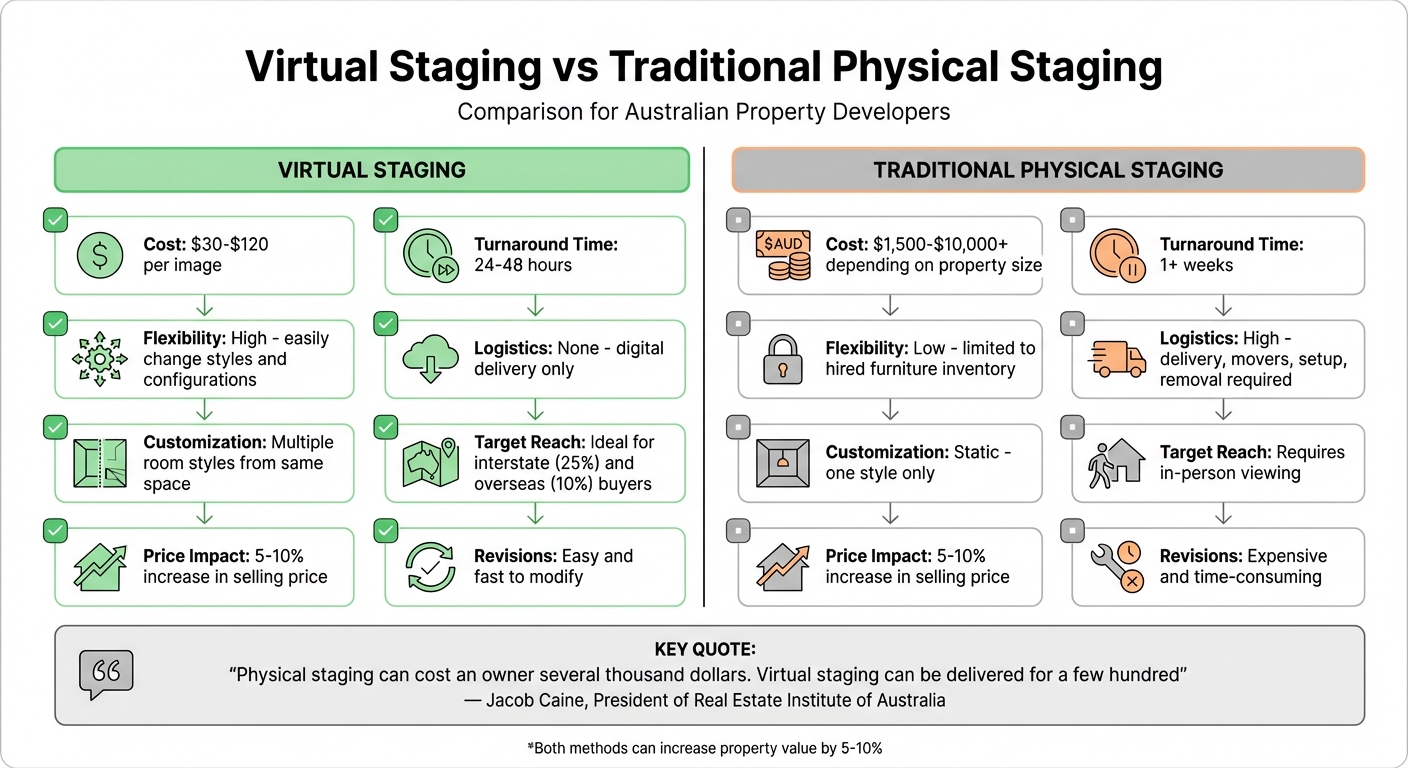
Virtual Staging vs Traditional Physical Staging Comparison for Australian Property Developers
Benefits of Virtual Staging for Off-Plan Sales
Lower Marketing Costs
Virtual staging can cut marketing expenses significantly. While physical staging costs anywhere from $1,500 to over $10,000 depending on the property size and location, virtual staging is far more affordable, typically ranging from $30 to $120 per image. For developers managing multiple properties in a new development, these savings can quickly become substantial.
Jacob Caine, President of the Real Estate Institute of Australia, captures this perfectly:
"Physical staging can cost an owner several thousand dollars. Virtual staging can be delivered for a few hundred".
In addition to lower upfront costs, virtual staging eliminates extra expenses like furniture delivery, installation labour, and potential damage to the property during setup or removal. For high-rise developments, this is especially useful, as it avoids the logistical challenges and costs tied to moving furniture into apartment towers. These savings not only reduce overall marketing costs but also allow developers to focus on creating compelling visualisations for potential buyers.
Helps Buyers See the Finished Product
One of virtual staging’s biggest advantages is its ability to help buyers imagine the property’s potential. By showcasing different room configurations – like a nursery, home office, or guest bedroom – buyers can better connect emotionally with the space. This is particularly valuable for unfinished properties, where envisioning the final look can be challenging.
Stephen Mutton, National Head of Network Development at LJ Hooker, explains:
"Virtual staging shows people what the potential of the empty space is. This, in turn, will create a desire to want to live there or own it and ultimately increase the value".
Unlike physical staging, which is static, virtual staging offers flexibility. The same room can be presented in various styles, appealing to different buyer groups. For instance, young professionals might be drawn to a modern home office design, while families could prefer seeing the space as a children’s bedroom. For remote buyers, who often rely solely on digital presentations, this adaptability is invaluable. This versatility makes virtual staging a powerful tool for off-plan sales by catering to diverse preferences and helping buyers visualise themselves in the space.
Faster Sales and Better Conversion Rates
Virtual staging doesn’t just save money – it also speeds up the sales process. Developers can receive virtually staged images within 48 hours, a stark contrast to the week or more it takes to complete physical staging. This allows properties to hit the market faster, capturing buyer interest early and reducing holding costs.
The benefits are clear in the numbers. Professionally staged properties – whether virtually or physically – can boost selling prices by an average of 5% to 10%. For a $750,000 apartment, this translates to an extra $37,500 to $75,000. Virtual staging achieves these results at a fraction of the cost, making it an attractive option for developers working within tight budgets.
However, the quality of virtual staging is crucial. Suzi Buckley, Buyer’s Agent at Cohen Handler, cautions:
"If a client turns up to physically inspect a property and realises it’s quite different to the images, it’s game over".
To maintain buyer trust, developers often choose human-led virtual staging, ensuring realistic lighting, accurate proportions, and designs that resonate with the target market. This attention to detail helps drive sales and strengthens the appeal of off-plan developments.
Challenges in the Australian Market
Helping Buyers Visualise Unfinished Properties
Selling off-plan properties comes with a major challenge: helping buyers imagine what the finished product will look like. The gap between digital renderings and the actual physical space can sometimes lead to disappointment, especially when virtual staging exaggerates room sizes or fails to replicate realistic lighting. For instance, some services shrink furniture to make rooms appear larger, misleading buyers about the actual dimensions. Poor-quality AI staging can make things worse, with issues like "floating" furniture, awkward lighting, or misplaced objects that ruin the illusion.
This problem is especially pronounced for high-end developments or buyers over 60, who are often more sceptical about off-plan purchases. To address these concerns, human-led virtual staging is key. Unlike cheaper AI solutions, human-led staging ensures that furniture proportions and lighting accurately reflect the final design. A great example is The Ace Residences in Bowral, where Mathieson Property used 1:1 scale walk-throughs on iPads and smart TVs to help potential buyers – particularly those over 60 – visualise their future homes. This approach bridged the gap between digital designs and real-world expectations, earning buyer trust and confidence.
Accurate portrayals and clear communication not only build trust but also ensure compliance with legal disclosure standards.
Following Staging Disclosure Requirements
Accurate virtual staging isn’t just about gaining buyer trust – it’s also a legal requirement. Australian consumer protection laws are stringent, and developers must avoid anything that could be considered misleading or deceptive. Under Section 18 of the Australian Consumer Law, any virtual staging that misrepresents a property – whether intentional or not – can lead to serious consequences. Generic disclaimers like "artist’s impression only" don’t provide sufficient legal protection.
One notable case highlights this risk. In August 2022, the Federal Court ruled in favour of Mr. and Mrs. Ripani, who had purchased a $10 million off-the-plan apartment in Melbourne. The promotional render showed a seamless opening between the living area and terrace, but the final design only allowed for a 3–4 metre opening. The court permitted the buyers to rescind the contract due to misleading advertising.
Dr Norman Katter, Barrister-at-Law, emphasises the importance of transparency:
"Anything less than a specific statement or finished plan clearly informing the prospective buyer that the render is not an image of the finished design and construction, will not be sufficient to displace the misrepresentation".
To stay compliant, developers should make it clear when images are virtually staged by labelling them as "Virtually Staged" or "Digitally Altered". They should also include precise disclaimers if renders don’t reflect the final design and ensure marketing materials are updated if plans change during construction.
Reaching Interstate and International Buyers
Remote buyers are a growing segment, with around 25% of viewers coming from interstate and 10% from international markets. These buyers often rely entirely on digital presentations to make their decisions, which means the quality of these visuals is crucial. Younger buyers, in particular, value authenticity and can quickly spot poorly executed staging. For those who visit later, seeing virtually staged images onsite can help reinforce the vision they saw online.
Jonny Tighe, Sales Agent at Ray White Bowral, explains the importance of comprehensive digital tools:
"The reaction we got from clients and buyers when we showed them the walk-throughs and tours… gives them peace of mind, comfort on what it is going to look like, and a much better feel when they are buying off the plan".
How to Use Virtual Staging in New Developments
Combining Virtual Staging with 3D Renders and Floor Plans
Virtual staging works best when it’s paired with other visual tools like 3D renders and floor plans. Tim Brickle from 3D Walkabout puts it perfectly:
"3D renders are the backbone of your marketing. They’ll be the focal point of your brochures, your website and your social channels. They are what grabs attention, because no one is going to click on a floor plan."
Once you’ve got your 3D render, virtual staging adds depth by introducing realistic furniture and props. This combination helps buyers picture themselves in the space – whether it’s a cosy Nordic-style living room or a garage with a family SUV. And it works: listings with virtual tours get 87% more views, and buyers engaging with interactive content are 93% more likely to enquire.
3D floor plans also play a major role, especially for buyers who struggle with traditional 2D layouts. They help show how rooms flow together and how spaces can be used. Some platforms now offer interactive display suites, letting buyers toggle between floor plans and life-sized walkthroughs, giving them full control over their experience [8, 11].
Accuracy is key. Keep everything at a 1:1 scale – buyers will notice if proportions feel off. Adding subtle, realistic touches like “spill light” (softer light beams) and slight imperfections in surfaces, like varied tile textures, can make renders feel more natural.
By combining these elements, you can create visuals that feel tailored to Australian buyers.
Designing for Australian Buyer Preferences
Virtual staging should reflect the diverse preferences of Australian buyers. For example, coastal areas tend to favour light, airy designs, while inner-city developments lean towards industrial aesthetics with sleek finishes. In suburban areas, practical layouts that cater to families work well.
A great example is Mathieson Property’s use of EnvisionVR to market The Ace Residences in Bowral in December 2023. They created 1:1 scale walkthroughs accessible on iPads and smart TVs, targeting buyers over 60 who were hesitant about purchasing off-plan. Jonny Tighe from Ray White Bowral shared:
"The reaction we got from clients and buyers when we showed them the walk-throughs and tours… gives them peace of mind, comfort on what it is going to look like, and a much better feel when they are buying off the plan."
High-quality renders for kitchens and bathrooms are essential since these spaces drive the most buyer interest. It’s also important to show how larger living areas can serve multiple purposes, like combining a lounge, dining, and study area [2, 3]. Adding lifestyle elements, such as children playing in a backyard or cosy home office setups, can help buyers envision how the space fits into their daily lives.
Details matter. Include features like realistic wood grains and natural depth of field to make visuals feel authentic. This is especially important for remote buyers, as about 25% of viewers are interstate and 10% are overseas.
To maintain this level of quality and appeal, many developers turn to white-label solutions.
Using White-Label Staging Solutions
Outsourcing virtual staging to professionals helps developers avoid common pitfalls like unrealistic imagery or inconsistent quality. White-label services are especially helpful for large developments where dozens of images need to be produced quickly and to a high standard.
The biggest advantage? Human-led design ensures quality. While AI staging services can cost as little as $10 per room, they often result in clunky images with floating furniture or awkward lighting. Maggie Hook from Little Hinges explains:
"The AI is just not smart enough yet. It doesn’t have the human touch that is required to style a property appropriately for its target market."
Professional white-label services, while pricier (a few hundred dollars per property), deliver photo-realistic results with consistent quality. For instance, Fast Virtual Staging offers services at $30 AUD per image, with a quick 12–24 hour turnaround, two free revisions, and the option to customise designs to suit Australian buyers.
When using white-label solutions, always label images as "Virtually Staged" or "Digitally Altered" to comply with Australian Consumer Law [4, 14]. Pair these images with detailed floor plans to help buyers visualise layouts. Also, make sure all visuals are optimised for mobile devices, as many buyers browse listings on their phones.
| Feature | Virtual Staging (Digital) | Traditional Staging (Physical) |
|---|---|---|
| Cost | Low (Hundreds of dollars) | High (Thousands of dollars) |
| Turnaround | Fast (Hours to a few days) | Slow (Days to weeks) |
| Flexibility | High (Change styles easily) | Low (Limited to hired inventory) |
| Logistics | None (Digital delivery) | High (Movers, delivery, setup) |
The speed, affordability, and flexibility of white-label virtual staging make it a great fit for off-plan developments, where multiple designs and layouts need to be marketed at once.
sbb-itb-f3f2f9e
Fast Virtual Staging: Services for Australian Real Estate Professionals
Fast Virtual Staging provides tailored virtual staging solutions designed to meet the unique demands of the Australian property market. Whether you’re marketing a cosy suburban home or a sleek commercial space, this service helps bring property listings to life with photo-realistic 3D renders.
Main Features and Benefits
Fast Virtual Staging specialises in creating high-quality, 3D-rendered images crafted by professional artists. These services cater to a wide range of property types, including residential homes, commercial spaces, and even outdoor areas like patios or office courtyards. With a rapid turnaround time of 12–24 hours, residential orders are guaranteed to be delivered within 24 hours – or they’re free.
Jack Dangerfield, a real estate agent with Ray White, highlights the impact of virtual staging:
"Adding virtual furniture to my property photographs always generates increased interest in my listings. I can choose my own style of furniture and turn-around times are fast for the quality."
Every order includes two free revisions, ensuring clients can fine-tune the results to their satisfaction. Additionally, an account manager is available to assist with style choices and manage revisions. Brad Minhinnick, Director at LINK Property Management, shares his experience:
"I found the platform easy to use for ordering my digital furniture for empty rooms to give my real estate listings a boost! The services were affordable and I really enjoyed working with my account manager."
For real estate photographers and property portals, the service offers white-label solutions, making it easy to integrate virtual staging into their offerings. Members of the Real Estate Photographer Club also enjoy a 20% discount, adding even more value. These features allow for flexible design options that appeal to a variety of buyer preferences.
Design Styles and Customisation Options
Fast Virtual Staging provides an array of design styles to suit different audiences, including Scandinavian, Modern, and French Country. This flexibility ensures that visuals align with the target demographic of each property. Clients can either submit a detailed design brief or leave the creative direction to the 3D artists, who will tailor the staging to the property’s type and location.
Customisation isn’t limited to interiors. The service extends to kitchens, living rooms, outdoor patios, and even commercial spaces like offices, retail areas, and industrial properties. With carefully scaled furniture and decor, buyers can better visualise the potential of unfinished or empty spaces. For larger projects, an account manager ensures consistency across all images, creating a unified look for marketing campaigns.
Pricing and Value for Developers
Fast Virtual Staging combines affordability with high-quality results. At just $30 AUD per image, it’s a cost-effective alternative to traditional physical staging, which often involves hefty expenses for furniture rentals, movers, and storage. The inclusion of two complimentary revisions per order adds further value by minimising the risk of unexpected costs.
For developers with specific needs – such as artist’s impressions or virtual renovations – the service collaborates with specialists like Laurent Visuals to deliver customised solutions. The ordering process is straightforward, involving five simple steps: selecting a product, choosing a style, submitting the order, rendering the images, and downloading the final product. This streamlined approach makes it an ideal choice for developers facing tight deadlines in their marketing efforts.
Case Studies: Australian Off-Plan Sales Success Stories
Australian property developers are increasingly turning to virtual staging to replace physical showrooms. This shift not only reduces marketing costs but also speeds up sales by engaging buyers in a more dynamic way. Here are some standout examples of how virtual tools are reshaping the off-plan sales landscape.
In February 2024, 5Point and ARC Project Marketing used EnvisionVR’s virtual platform to market Ophira, a beachfront project in Palm Beach, Queensland. Remarkably, over 50% of the $7 million apartments were sold off-the-plan using this technology. Chris Wayman, Development and Design Manager at 5Point, shared:
"Ophira is a boutique, beachfront development, and the time and cost of a display suite were too onerous for the project… EnvisionVR’s Ophira Virtual Experience takes them through the project perfectly."
Dylan Molloy, Director at ARC Project Marketing, elaborated on the impact:
"EnvisionVR elevates the experience for buyers, allowing them to walk through the entire apartment and out to the balcony in real scale, appreciate the spectacular ocean and hinterland views they will have from each window, and review finishes throughout."
This innovative approach not only streamlined the sales process but also set a precedent for the future of digital property marketing.
Back in September 2019, Perth-based DevelopWise launched Sanctuary Mount Pleasant with the help of Realspace‘s interactive 3D digital display suite. By the official launch date, 30% of the development had already been sold. John Woon, Managing Director of DevelopWise, highlighted how the technology extended buyer engagement:
"The digital display suite lets us continue selling once construction has started. We don’t have to remove our display suite and we’ll continue to sell until the last apartment."
Gareth Ross, Managing Director at Buildmedia, echoed this sentiment:
"Our buyer meetings have been more in-depth and informative… Half-hour appointments tend to stretch to one and a half hours on average – which is a great thing as they are a lot more engaged and informed."
This approach not only attracted buyers early but also maintained interest throughout the construction phase.
Another example is Aqualand‘s AURA development in North Sydney, launched in December 2021. The project featured an immersion gallery created by DisplaySweet and Binyan Studios. With interactive walls and rooms, the showroom was a finalist for the AREA Awards’ ‘Game Changer of the Year.’ Alex Adams, Head of Sales and Marketing at Aqualand, explained:
"A big feature of the display showroom is the interactive digital masterplan… it allows [clients] to make informed decisions and visualise the long-term value of their investment."
These examples reflect broader industry trends. Data shows that immersive tours can shorten sales cycles by up to 70% and significantly increase buyer interest. In fact, 73% of buyers now consider 3D virtual tours essential to their decision-making process, and listings with immersive media are 93% more likely to generate enquiries.
These case studies highlight how virtual staging is revolutionising off-plan sales in Australia, making the buying process more engaging and efficient.
Conclusion
Virtual staging has become a game-changer for marketing new developments and off-plan properties across Australia. As a strong digital presence becomes essential in property marketing, high-quality visuals play a key role in grabbing buyers’ attention and helping them imagine the potential of empty or unfinished spaces. This emotional connection often drives purchasing decisions.
Compared to traditional staging, virtual staging offers significant advantages in terms of cost and speed. It eliminates the expenses and logistical hurdles of physical staging, enabling developers to start marketing campaigns almost immediately after construction photos or 3D renders are ready. This quick turnaround is especially important for off-plan sales, where timing is critical.
Another standout feature is the ability to showcase various room configurations. For instance, a bedroom can be styled as a nursery or a home office, catering to a wide range of buyer preferences without adding extra costs. This versatility is particularly useful for reaching the approximately 25% of interstate and 10% of overseas buyers who rely entirely on digital tools and cannot attend in-person inspections. By leveraging these strengths, developers can better meet the needs of both local and remote audiences.
Australian real estate professionals are embracing virtual staging to keep up with changing buyer expectations in the digital age. With its lower costs, faster turnaround, and ability to reach broader markets, virtual staging is proving to be an effective way to enhance property appeal and boost sales. This approach helps properties stand out in an increasingly competitive and digital-focused market.
FAQs
Does virtual staging comply with Australian Consumer Law?
Yes, virtual staging must align with the Australian Consumer Law (ACL), which strictly prohibits misleading or deceptive conduct in trade or commerce. This means that any digitally enhanced images must accurately represent the property and not distort its actual condition. For instance, when furniture or design elements are added to an empty space, it’s crucial to clearly state that these images are digitally altered, often using disclaimers like ‘artist’s impression’.
If such disclosures are omitted or virtual staging is presented as an exact reflection of the property’s current state, it could be deemed misleading, potentially leading to legal repercussions. Even with disclaimers, professionals must ensure that the enhancements remain realistic and do not exaggerate the property’s features. Maintaining transparency is essential for complying with the law and building trust with potential buyers.
How does virtual staging benefit buyers purchasing remotely?
Virtual staging offers a practical solution for remote buyers, helping them picture a property’s possibilities. It transforms empty or unfinished spaces into fully furnished, inviting rooms, making it easier for potential buyers to imagine themselves living there. This approach is especially helpful for off-plan sales or new developments, where blank spaces can feel impersonal and hard to connect with.
By presenting a lifelike and engaging view of the property, virtual staging boosts buyer confidence, sparks greater interest, and makes online browsing more immersive. It’s an effective way to make properties stand out, particularly for those unable to visit in person.
How does virtual staging help market off-the-plan properties in Australia?
Virtual staging breathes life into off-the-plan properties by digitally furnishing and decorating empty or incomplete spaces. This technique helps potential buyers see the property’s possibilities and picture themselves living there, even before the building is finished.
By highlighting both the practicality and style of a space, virtual staging can spark an emotional connection with buyers. This often translates to quicker sales and more competitive offers. It’s a smart solution for turning blank spaces into dream homes, perfectly suited for Australia’s property market.