
When selling property in Australia, staging plays a big role in attracting buyers and increasing sale prices. You have two main options: virtual staging and physical staging. Virtual staging uses digital tools to furnish photos of empty homes, while physical staging involves renting and arranging real furniture. Both methods aim to make properties more appealing, but they differ in cost, speed, and impact. Here’s a quick breakdown:
- Virtual Staging: Costs $30–$120 per image, delivers in 24–48 hours, and is ideal for online listings. However, the home remains empty during inspections.
- Physical Staging: Costs $2,000–$8,000+ per property, takes 1–2 weeks to set up, and provides a hands-on experience for buyers during open homes.
Key Insights:
- Staged homes in Australia sell for 5%–15% more than unstaged ones.
- Virtual staging is better for tight budgets and vacant properties.
- Physical staging works well for luxury homes and in-person inspections.
Choosing the right method depends on your budget, timeline, and buyer expectations. For the best results, consider combining both approaches: use virtual staging for online listings and physical staging for key areas during inspections.
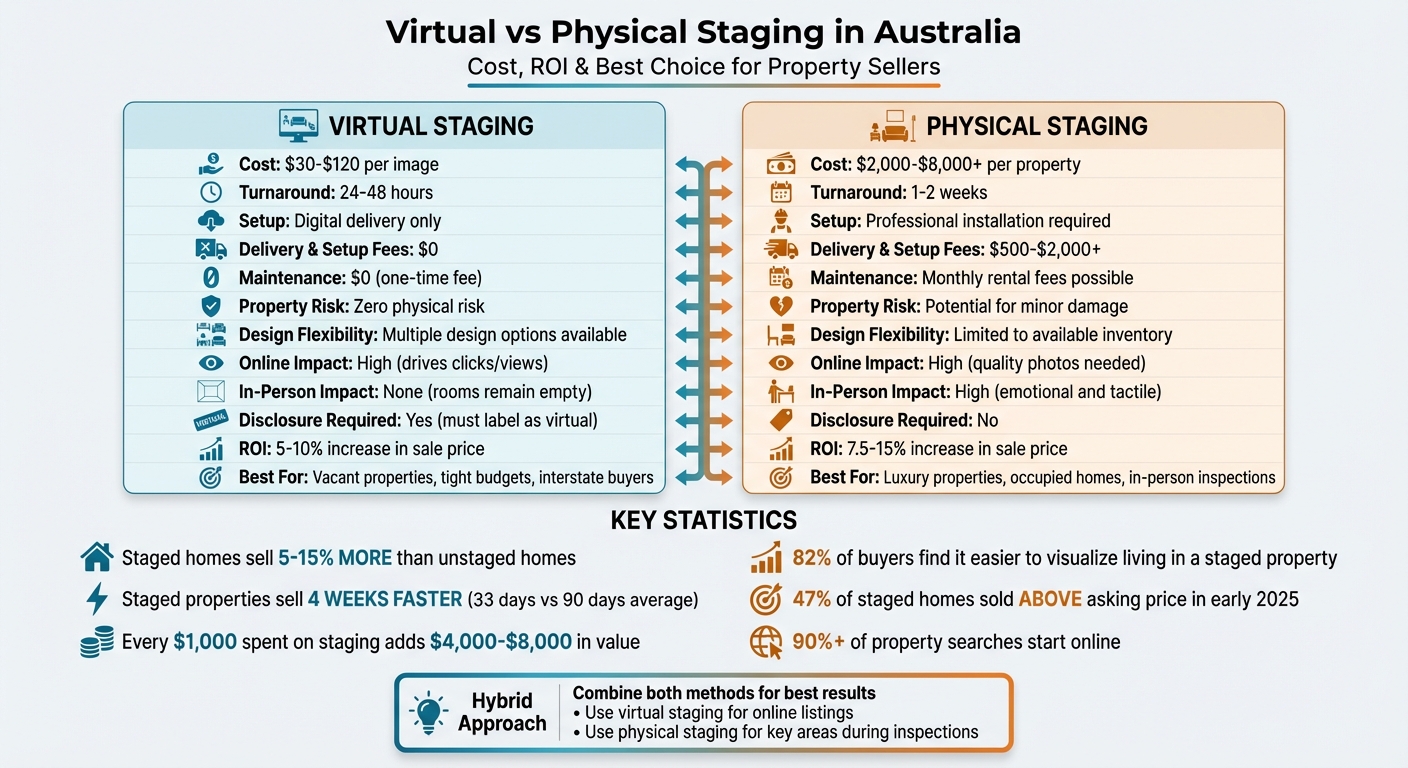
Virtual vs Physical Staging in Australia: Cost, ROI and Performance Comparison
Home Staging in 2025: Physical vs Virtual Staging (and the Cost of Doing Nothing)
What is Virtual Staging?
Virtual staging is a digital technique where 3D artists use computer-generated imagery to add lifelike furniture, decor, and accessories to photos of empty or outdated properties. This approach skips the need for physical furniture, producing polished images that help potential buyers imagine a property’s possibilities – without the hassle of traditional staging.
Here’s how it works: sellers or agents upload photos of empty rooms, select from Australian design styles, and provide specific instructions. The 3D artists then add scaled digital furnishings, ensuring lighting, shadows, and proportions are spot-on. Within 24–48 hours, the completed images are delivered via a download link, ready for use on listing platforms.
How Virtual Staging Works
The process starts with uploading high-quality photos of the vacant property and choosing a preferred design style. You can pick from popular Australian aesthetics like Coastal, Contemporary, Hamptons, Scandinavian, or Mid-Century Modern. There’s also the option to customise the space – for example, transforming a room into a home office, nursery, or guest bedroom.
After submitting your brief, 3D artists furnish the space digitally, maintaining accurate scale and perspective. The final images are delivered within 24–48 hours, ready to showcase.
Benefits of Virtual Staging
One major draw of virtual staging is its affordability. In Australia, it typically costs between $30 and $120 per image – far less than the expense of physical staging. Plus, it eliminates costs tied to furniture rental, delivery, and potential damage.
Brad Filliponi, Co-Founder of Box Brownie, explains: "It is the best way to bring a cold vacant home to life easily. It helps to show its full potential".
Speed is another key advantage. While physical staging might take a week or longer to arrange, virtual staging can be completed in as little as 12 to 48 hours. The flexibility is also noteworthy – you can present the same room in multiple styles or showcase different uses, like turning a spare room into a nursery or home office, catering to diverse buyer preferences.
Stephen Mutton, National Head of Network Development at LJ Hooker, emphasises its impact: "Virtual staging shows people what the potential of the empty space is. This, in turn, will create a desire to want to live there or own it and ultimately increase the value".
These benefits are well-illustrated by Fast Virtual Staging’s tailored services.
Fast Virtual Staging Features
Fast Virtual Staging offers both residential and commercial staging at a competitive price of $30 AUD per image, with a guaranteed 24-hour turnaround for residential projects. The service includes two free revisions, ensuring the final images meet your expectations. You can choose from a variety of design styles – such as Scandinavian, French Country, or Modern – designed to appeal to Australian buyers.
For real estate photographers and agencies, the service also provides white-label solutions, allowing you to brand the renders as your own. Each client is assigned an account manager to simplify communication and maintain consistency across projects. Fast Virtual Staging employs skilled 3D artists who create highly realistic renders, capturing room dimensions, lighting, and style with precision.
What is Physical Staging?
Physical staging – commonly referred to as property styling in Australia – involves using actual furniture, artwork, and decor to showcase a home’s potential. Unlike digital staging, this approach allows buyers to physically experience a fully furnished property during open houses or private inspections.
This method helps buyers form an emotional connection, better understand the scale of each room, and make sense of tricky layouts. By using real furniture, staging not only highlights how spaces can be utilised but also makes it easier for buyers to imagine their future lifestyle in the home.
"First impressions count for everything, and an experienced stager will know the desires of the target demographic and be able to trigger a positive emotional response." – OpenAgent
The numbers speak for themselves: 82% of buyers find it easier to visualise living in a staged property. A study spanning six years by Cape Cod Residential and the Interior Design Association revealed that staged homes in Brisbane achieved an average price premium of $69,017, with 30% of properties earning over $100,000 more than their asking price.
How Physical Staging Works
The staging process begins with a stylist visiting the property to assess its layout, consider the target demographic, and take reference photos. After this consultation, the seller receives a detailed quote and signs a contract that typically covers a 4- to 6-week rental period for the staging items.
Before staging begins, homeowners are advised to declutter, remove personal items, and make minor repairs. Once the property is ready, the staging company delivers and arranges carefully selected furniture and decor. Depending on the size of the property, this setup can take anywhere from a few hours to an entire day. Stylists prioritise key areas like the entrance, living room, dining area, and master bedroom to ensure these spaces shine in photos and during inspections.
When the property sells or the sales campaign ends, the staging company removes all items in a process known as "de-staging." Typically, the furniture is rented for the duration of the campaign, which usually lasts 5 to 6 weeks.
"What we found is that styled properties are selling four weeks faster than properties on average." – David McLean, General Manager, Furnish & Finish Property Styling
This efficient process often leads to quicker sales and higher offers.
Benefits of Physical Staging
The biggest draw of physical staging is the immersive, hands-on experience it offers. Buyers can walk through the space, sit on the furniture, and even open cupboard doors. This tactile interaction is especially appealing in Australia’s competitive property market, where first impressions matter.
Physical staging also delivers strong financial results. Professionally styled homes often sell for 7.5% to 12.5% more than unstyled ones. On average, staged homes in Australia sell within 33 days, compared to 90 days for properties that aren’t staged. For every $1,000 spent on staging, sellers typically see a return of $4,000 to $8,000 in added value.
This approach is particularly effective for vacant homes, luxury properties, spaces with unconventional layouts, and older or rental properties that need to feel "move-in ready."
Cost Comparison: Virtual vs Physical Staging
Virtual staging is far more budget-friendly compared to physical staging. The typical cost for virtual staging ranges from $30 to $100 per image, while physical staging can set you back $2,000 to $8,000 or more per property. For sellers operating on limited budgets, this price gap can be a game-changer.
"Physical staging can cost an owner several thousand dollars. Virtual staging can be delivered for a few hundred."
- Jacob Caine, President, Real Estate Institute of Australia
To put this into perspective, staging a property in Sydney or Melbourne generally costs between $2,000 and $8,000+, whereas in Brisbane and Adelaide, the range is closer to $1,700 to $4,000.
The pricing structures also differ significantly. Virtual staging comes with a one-time fee per image, with no added costs for logistics or setup. On the other hand, physical staging includes furniture rental for 4 to 8 weeks, along with delivery, professional setup, insurance, and removal fees. Some providers even require a minimum 3-month rental agreement.
"There’s no furniture hire. There’s no delivery charge. It’s logistically easier – you don’t have trades lugging things up to the 28th floor."
- Maggie Hook, Head of Growth, Little Hinges
Here’s a detailed breakdown of the cost differences:
Cost Breakdown Table
| Expense Type | Virtual Staging | Physical Staging |
|---|---|---|
| Base Cost | $30–$100 per image | $2,000–$8,000 per property |
| Delivery & Setup | $0 (digital delivery) | $500–$2,000+ (labour & transport) |
| Additional Fees | $0 (one-time fee) | Consultation fees, insurance, storage |
| Maintenance | $0 (one-time fee) | Monthly rental fees (after initial period) |
| Turnaround | 1–3 days | 1–2 weeks |
ROI and Performance Comparison
Both virtual and physical staging offer measurable returns, but their effectiveness varies based on the type of property and budget. Sellers can expect a significant boost in property value, with every $1,000 spent on staging typically adding $4,000 to $8,000. The main differences lie in the speed of results and the upfront costs involved.
Virtual Staging ROI
Virtual staging provides results at a much lower cost. With over 90% of property searches starting online, a strong digital presence is essential. Virtual staging capitalises on this by creating an appealing first impression, and with a quick turnaround of 24–48 hours, listings can go live sooner, cutting down on holding costs like mortgage payments and utilities.
"Virtual staging shows people what the potential of the empty space is. This, in turn, will create a desire to want to live there… and ultimately increase the value and or competition on the property."
- Stephen Mutton, National Head of Network Development, LJ Hooker
The cost advantage is clear: virtual staging is 75–90% cheaper than physical staging while still increasing sale prices by 5–10%. This makes it a great option for entry-level properties where budgets are tighter. Additionally, professionally staged homes spend 33–50% less time on the market, leading to further savings on carrying costs.
While virtual staging is ideal for affordability and speed, physical staging offers a different value proposition, especially for high-end properties.
Physical Staging ROI
Physical staging requires more upfront investment but can yield higher returns for premium properties. For example, a 4-bedroom Sydney home valued at $3,000,000 saw its sale price rise by 10% following an $8,000 staging investment, adding $300,000 in value. Similarly, a 4-bedroom Adelaide property worth $650,000 gained an extra $48,750 (7.5% ROI) with a $2,200 staging cost.
The numbers are compelling: 47% of staged homes sold above the asking price in early 2025, and 17% of agents report that physical staging increases the sale price by 1% to 5%. Although physical staging typically costs less than 1% of the property’s value, it can boost sale prices by 7.5% to 15%. Setup, however, takes at least a week, compared to the near-instant results of virtual staging.
"It is, quite simply, the most cost-effective way to present a property to the market."
- Suzi Buckley, Buyer’s Agent, Cohen Handler
The decision ultimately depends on the property and audience. Virtual staging shines in generating online interest and quick turnarounds, while physical staging is best suited for luxury homes, where buyers expect a polished, move-in-ready presentation.
sbb-itb-f3f2f9e
Pros and Cons Comparison
When comparing virtual and physical staging, both methods can enhance property appeal, but they achieve this through very different approaches. Virtual staging is all about creating a strong online presence. It’s quick, cost-effective, and offers the flexibility to showcase various design styles without the hassle of transporting furniture. Plus, it eliminates any risk of property damage and avoids the logistical challenges associated with moving furniture. It’s even a more eco-conscious option, as it skips the need for physical materials and transport.
However, virtual staging isn’t without its drawbacks. The most glaring issue? The home remains empty during in-person inspections. This can leave buyers underwhelmed, especially if they’ve been drawn in by the beautifully staged images online. As Stephen Mutton, National Head Of Network Development at LJ Hooker, points out:
"The only potential downside of virtual staging is that the styling is not there upon inspection. It plants the seed of possibility".
Another consideration is transparency. Sellers are required to disclose that the images have been digitally enhanced. This is crucial for maintaining trust and avoiding any legal issues.
On the other hand, physical staging excels in creating a deep, emotional connection during property walk-throughs. Seeing and feeling a well-furnished space helps buyers grasp the scale and flow of a home. It’s no surprise that 83% of buyers’ agents say staging makes it easier for potential buyers to envision the property as their future home.
But physical staging comes with its own set of challenges. It’s significantly more expensive, with costs ranging from $1,500 to over $10,000. The setup process can take up to two weeks, and there’s always a slight risk of property damage, like scuff marks or scratches. Plus, design choices are limited to the staging company’s available inventory.
Pros and Cons Table
| Factor | Virtual Staging | Physical Staging |
|---|---|---|
| Cost | Low ($30–$120 per image) | High ($1,500–$10,000+) |
| Turnaround | 24–48 hours | 1–2 weeks |
| Design Flexibility | Multiple design options | Limited to available inventory |
| Online Impact | High (drives clicks/views) | High (quality photos needed) |
| In-Person Impact | None (rooms are empty) | High (emotional and tactile) |
| Property Risk | Zero physical risk | Potential for minor damage |
| Environmental Impact | Low (digital only) | Higher (furniture transport) |
| Disclosure Required | Yes (must label as virtual) | No |
| Best For | Vacant homes, tight budgets | Luxury properties, occupied homes |
When to Choose Virtual Staging
Virtual staging shines when you want to make a strong online impact without the hefty price tag of traditional staging. In today’s competitive market, where empty rooms often fail to attract buyers, visually appealing listing photos are a must.
Best Use Cases for Virtual Staging
Virtual staging works particularly well in these scenarios:
- Vacant properties: Empty spaces can leave buyers struggling to imagine how rooms might look fully furnished. Virtual staging bridges this gap, showing how furniture can fit and flow within the space.
- Budget-conscious sellers: Traditional staging can cost anywhere from $1,500 to over $10,000. In contrast, virtual staging, priced between $30 and $120 per image, offers a more affordable option that can still boost selling prices by 5% to 10%.
- Interstate and overseas buyers: For those unable to attend in-person inspections, high-quality virtual staging serves as an essential tool, providing a clear vision of the property.
- Properties with flexible room uses: Virtual staging allows you to showcase a room in multiple ways – for example, a small bedroom can be presented as a nursery or a home office. This flexibility appeals to a broader range of buyers.
To complement the online appeal, consider displaying printed versions of the virtually staged images during open homes. This helps buyers visualise the potential of what might otherwise be an empty room.
Fast Virtual Staging Solutions
Fast Virtual Staging offers tailored solutions starting at $30 per image, with quick turnaround times and dedicated account support. Their skilled 3D artists create photo-realistic furniture, ensuring accurate scaling and lighting that seamlessly integrates with your property photos.
Key highlights of the service include:
- 24-hour delivery guarantee: For residential properties, orders are delivered within 24 hours. If they miss the deadline, you don’t pay a cent. This speed lets you list your property sooner, capturing buyer interest during the crucial early days of your campaign.
- Complimentary revisions: Each order includes two free revisions, so the final images can be fine-tuned to match your vision and target audience.
Jack Dangerfield from Ray White shares his experience:
"Adding virtual furniture to my property photographs always generates increased interest in my listings. I can choose my own style of furniture and turn‐around times are super‐fast for the quality."
Fast Virtual Staging caters to both residential and commercial properties and even offers white-label solutions for real estate photographers. These include a 20% discount and branded services, allowing photographers to expand their offerings.
This service ensures your property stands out, providing a practical and efficient alternative to traditional staging while aligning with the strategic goals discussed earlier.
When to Choose Physical Staging
While virtual staging is great for generating online buzz, physical staging takes centre stage during in-person inspections by creating a tangible and emotional connection for potential buyers.
Best Use Cases for Physical Staging
Luxury and Premium Properties
In high-end markets like Sydney and Melbourne, buyers often expect a polished, high-quality experience. Physical staging plays a crucial role here. For instance, staging a $3,000,000 Sydney home for $8,000 could lead to a 10% price increase, potentially adding $300,000 to its value.
Properties with Unusual or Multi-Functional Layouts
Homes with unique or flexible layouts benefit immensely from physical staging. Mark Kentwell explains:
"The benefit of real staging is that it shows people how to live in the home; for example, a large living space can be used for a lounge/dining/sitting or lounge/sitting/study, and if this was un-staged on inspection they would not be able to see the multi-functional element of the property".
Preventing the "Disappointment Gap"
Physical staging also helps avoid the "disappointment gap" – when buyers, impressed by online photos, find the property underwhelming during an inspection. Suzi Buckley, a Buyer’s Agent at Cohen Handler, notes:
"If a client turns up to physically inspect a property and realises it’s quite different to the images, it’s game over".
By aligning the in-person experience with online expectations, physical staging ensures buyers remain engaged.
Occupied Homes
For homes that are still occupied, professional staging can refine the existing décor, creating a cohesive and appealing look that’s ready for the market. This approach can transform a lived-in space into one that feels fresh and inviting.
These advantages highlight the value of physical staging, making it a critical tool to consider when planning your strategy for the Australian property market.
Choosing the Right Staging Method in Australia
Decision Factors
When deciding on a staging method, think about your budget, timeline, property type, and who you’re trying to attract. For smaller budgets and quick turnarounds (12 to 48 hours), virtual staging is a smart option. On the other hand, physical staging typically takes at least a week for consultations and setup.
Since most buyers start their property search online, it’s crucial to align your staging approach with digital trends. If your audience includes both local and interstate or international buyers, make sure your digital and in-person presentations complement each other.
The current state of the property also plays a role. Virtual staging shines when showcasing vacant properties, allowing buyers to imagine the possibilities. Physical staging, however, is a better fit for occupied homes or high-end listings, where a polished and tactile experience is often expected during inspections.
Combining Both Methods
Using a mix of virtual and physical staging can often deliver the best results. Virtual staging is great for creating online buzz, while physical staging adds that extra touch during in-person visits. Together, they create a seamless experience from first impressions online to final decisions in person.
A practical hybrid approach could involve using virtual staging to enhance your online listings and then displaying printed images of the staged rooms during open houses. This strategy helps buyers connect the digital presentation with the physical space. For properties with multiple bedrooms, you might physically stage key areas like the living and dining rooms, while relying on virtual staging for secondary spaces like spare bedrooms or home offices.
Tailoring Your Staging Approach
Virtual staging is ideal for budget-conscious sellers, vacant properties, and quick turnarounds. It’s especially effective for entry-level homes. Physical staging, on the other hand, works best for luxury properties or when creating an emotional connection is key to securing a premium sale.
The key is to match your staging method to the property’s price point, timeline, and buyer expectations. By aligning digital appeal with in-person impact, you build trust and increase the likelihood of closing the sale. This balanced strategy combines the benefits of both modern technology and traditional staging techniques, as discussed earlier.
FAQs
What’s the best way to choose between virtual and physical staging for my property?
Choosing between virtual staging and physical staging comes down to your budget, timeline, and the property you’re selling.
Virtual staging is a more affordable option, usually costing between A$30 and A$120 per image. It’s also fast, with turnaround times of just 12–48 hours. This approach works particularly well for online listings, helping potential buyers imagine how a space could look when furnished. That said, it’s crucial to ensure the digital designs look realistic to avoid misleading buyers.
On the other hand, physical staging involves real furniture and décor, creating a warm and inviting atmosphere for open houses or in-person viewings. While this option is pricier – ranging from A$2,000 to A$8,000 – and takes longer to set up (1–3 weeks), it can make a strong impression, especially for high-end properties or buyers who value seeing the space in person.
The choice ultimately depends on your goals and audience. Virtual staging is perfect for quick, budget-friendly online marketing, while physical staging works best for premium properties and buyers who prefer a hands-on experience.
What is the cost difference between virtual staging and physical staging in Australia?
The price gap between virtual staging and physical staging in Australia is quite noticeable. Virtual staging tends to be the more affordable choice, usually costing between A$30 and A$120 per image, with some providers charging as little as A$30–A$80 per room. On the other hand, physical staging, which involves renting actual furniture and décor, can cost anywhere from A$2,000 to A$8,000 for a full property setup. The exact price depends on the home’s size and desired style.
Virtual staging works best for online property listings and sellers who need a quick, budget-friendly option. It often comes with a fast turnaround time of just 24–48 hours. Physical staging, though pricier, offers a more immersive, hands-on experience, making it a popular choice for high-end properties or homes requiring in-person viewings.
Can virtual staging help attract online buyers if the property is empty during inspections?
Virtual staging is an excellent way to highlight a property’s potential, particularly when it’s vacant during inspections. By adding digital furnishings to images, buyers can better picture how the space might look once it’s fully styled, making the listing far more engaging and attractive.
In Australia, where more than 90% of property searches start online, having high-quality, virtually staged images can give your listing a real edge. These enhanced visuals showcase the home’s best features, helping to create a powerful first impression well before potential buyers even set foot inside.